Chaco Culture National Historical Park
AtoZ Places Bucket Location


Abandoned & Ghost Towns

Ancient Ruins

Caves

Desert

Forest

Historical

Hot Springs

Lakes & Rivers

National & State Parks

Peaks




Chaco Culture National Historical Park in northwestern New Mexico is one of the most significant and least visited archaeological sites in North America — a UNESCO World Heritage Site preserving thirteen major Ancestral Puebloan great houses built between 850 and 1250 CE in a remote canyon that served as the ceremonial, economic, and astronomical center of a civilization spanning 50,000 square miles of the Colorado Plateau.
Ancient Ruins

Wildlife

Hiking

Exploring

Camping

Camping: Developed campsites available by reservation; fees required.
Cell service nonexistent — download maps and have paper backup

FEE: Required
No firewood available and no wood gathering permitted — bring charcoal or camp stove

Water: Available at this site.
More Info
Plants Foraged
Nearby Locations
Aztec Ruins National Monument

Chaco Culture National Historical Park
There are places that change your understanding of what was here before. Chaco Canyon is one of them.
Thirty miles of unpaved road from the nearest highway brings you to a remote canyon in northwestern New Mexico where the Ancestral Puebloan people built something extraordinary — a planned complex of massive multi-story great houses aligned with solar and lunar cycles, connected to hundreds of outlying communities across the Southwest by a network of engineered roads, producing an astronomical and architectural achievement that the canyon's remote location has helped preserve for nearly a thousand years. It is genuinely one of the most remarkable places in North America. We need to return.
Luca, Matthew and I camped at Gallo Campground July 5–6, 2021 — part of an eleven-day road trip through New Mexico and Colorado. We did the 9-mile loop road across parts of two days — the evening we arrived and the following morning — working through the five major sites at a pace the canyon deserved.
The Scale of What Was Here

Between approximately 850 and 1250 CE the Ancestral Puebloan people — sometimes called the Anasazi, though many descendant communities prefer Ancestral Puebloan — built at least thirteen major great houses in Chaco Canyon and hundreds of smaller sites. These were not villages. They were planned, multi-story, multi-room structures of dressed stone masonry — aligned precisely with the cardinal directions, the winter and summer solstices, and the 18.6-year lunar cycle. The largest, Pueblo Bonito, contained at minimum 650 rooms and rose four to five stories in sections. The engineering precision of the masonry, the astronomical alignments of the structures, and the scale of the road network connecting Chaco to outlying communities across a 50,000-square-mile influence area make this one of the most sophisticated pre-Columbian civilizations north of Mexico.
Chaco was a UNESCO World Heritage Site in 1987 and an International Dark Sky Park in 2013 — the same canyon, the same sky the Ancestral Puebloans mapped with their architecture, still dark enough to see what they were looking at.
The 9-Mile Loop — Five Major Sites
The 9-mile loop road through the canyon is the backbone of a Chaco visit — accessing five of the major great houses in sequence. We split the loop across the evening arrival and the following morning — the right approach for giving each site adequate time without rushing.
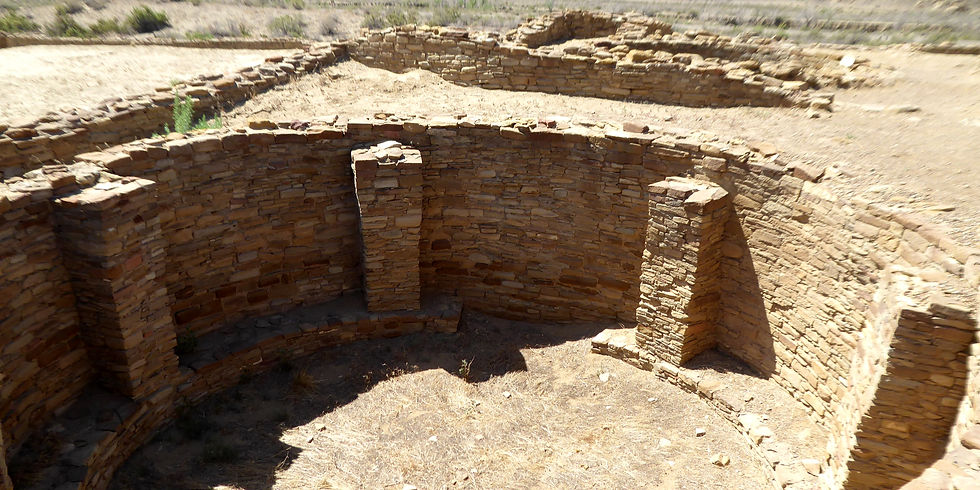
Pueblo Bonito is the highlight — the largest, most excavated, and most visited great house in the canyon. Walking into Pueblo Bonito is unlike any other archaeological site in the Southwest. Room after room opens into the next — small doorways connecting chambers, kivas sunk into the ground, the great curved back wall rising three stories in sections with the precision of a building constructed by people who knew exactly what they were doing. The scale is not apparent from photographs. Standing inside and looking up at the remaining walls and across the expanse of interconnected rooms makes the inhabitation of this place suddenly real in a way no description prepares you for. We found shade in one of the rooms — the thick stone walls keeping the interior significantly cooler than the canyon floor outside in the July heat. A genuinely useful architectural feature that 800 years have not diminished.
Chetro Ketl — adjacent to Pueblo Bonito and connected by the Petroglyph Trail between the two sites. We encountered the rattlesnake here — coiled in the shade at the base of the Chetro Ketl wall, using the same thermal logic we were using to stay cool. It was unbothered and we gave it appropriate space. The wall of Chetro Ketl is one of the finest examples of Chacoan masonry in the canyon — the precision of the stone courses visible up close in a way that stops you.
Rock Art — two types of wall art visible along the trails near camp and between sites. The rock art at Chaco spans multiple periods and multiple styles — some of the petroglyphs predate the great house construction, others were made during the Chacoan period. Walking the trails near Gallo Campground in the evening light with the canyon quiet delivers some of the most satisfying rock art viewing in the park.
Gallo Campground

Gallo Campground sits one mile east of the visitor center, tucked among fallen boulders and cliff faces in Gallo Wash — a rugged, genuinely beautiful campsite in a canyon environment surrounded by petroglyphs, a small cliff dwelling visible from camp, and the high desert landscape of the Colorado Plateau.
32 individual sites — 27 tent or small RV, 5 RV only, 2 group sites. Each site has a picnic table and fire grate with grill. Flush toilets and potable water available at the visitor center — no showers, no hookups. No cell service in the park. No firewood available and no wood gathering permitted — bring your own charcoal or camp stove.
Cost at time of our visit:
Campsite: $20/night — reserve at Recreation.gov
Vehicle pass: $25
The campground is as good as the park — the evening light on the canyon walls from Gallo, the dark sky that justified the International Dark Sky Park designation, and the silence of a remote canyon with no light pollution and no cell service is a camping experience that belongs on the same tier as the archaeological sites in the canyon.
The Road In
Getting to Chaco is part of the experience — and part of the commitment. Two roads access the park:
From the north (recommended): US-550/44 to Road 7900 — three miles east of Nageezi and fifty miles west of Cuba. Follow Road 7900 for five paved miles then turn right onto Road 7950. Pavement continues for several miles then transitions to 13 miles of unpaved road.
From the south: NM Route 57 — 20 miles of rough unpaved road.
The unpaved road is passable for most vehicles in dry conditions — impassable when wet. Always check road conditions before the drive in. Call (505) 786-7014 for current road condition information. Do not attempt after rain.
The Dark Sky
Chaco Culture National Historical Park is an International Dark Sky Park — the remote canyon location with no nearby cities and no light pollution produces one of the darkest skies accessible to a campground in the American Southwest. The Ancestral Puebloan people who built Chaco aligned their great houses with astronomical precision — the night sky above Gallo Campground is the same sky they were working with. It is worth staying up for.
More Information (2026):
Pets not permitted on front country trails — allowed on backcountry trails on 6-foot leash
Sites and trails open 7 AM–9 PM (May–Oct), 7 AM–5 PM (Nov–Feb), 7 AM–7 PM (Mar–Apr)
Guided tours of Pueblo Bonito: 10 AM and 2 PM, April through October
Night Sky program available April through October
#ChacoCulture #PueblosBonito #AncestralPuebloans #UNESCO #WorldHeritageSite #NewMexico #AZPlaces #AncientRuins #DarkSkyPark #ArchaeologyLovers #NationalPark #GalloCampground #ColoradoPlateau #SouthwestHistory #NativeAmericanHistory
Campground


Best Seasons & Temperatures
Spring and fall are the best seasons — April through early June and September through October when temperatures at 6,200 feet are manageable. Summer heat in the canyon is significant — July as we experienced delivers intense midday heat in the open canyon with limited shade. The thick walls of the great houses provide genuine shade relief — take advantage of it during midday hours. Winter visits are possible in dry conditions but the unpaved access road may become impassable after snow. The park's International Dark Sky designation means any season with clear nights is worth staying for after dark. Always check road conditions before attempting the drive regardless of season — (505) 786-7014.
Chaco Culture National Historical Park Pueblo Bonito great house New Mexico Ancestral Puebloan ruins UNESCO World Heritage Site AZ Places
July 5-6 2021