
Wupatki National Monument
AtoZ Places Bucket Location


Abandoned & Ghost Towns

Ancient Ruins

Caves

Desert

Forest

Historical

Hot Springs

Lakes & Rivers

National & State Parks

Peaks


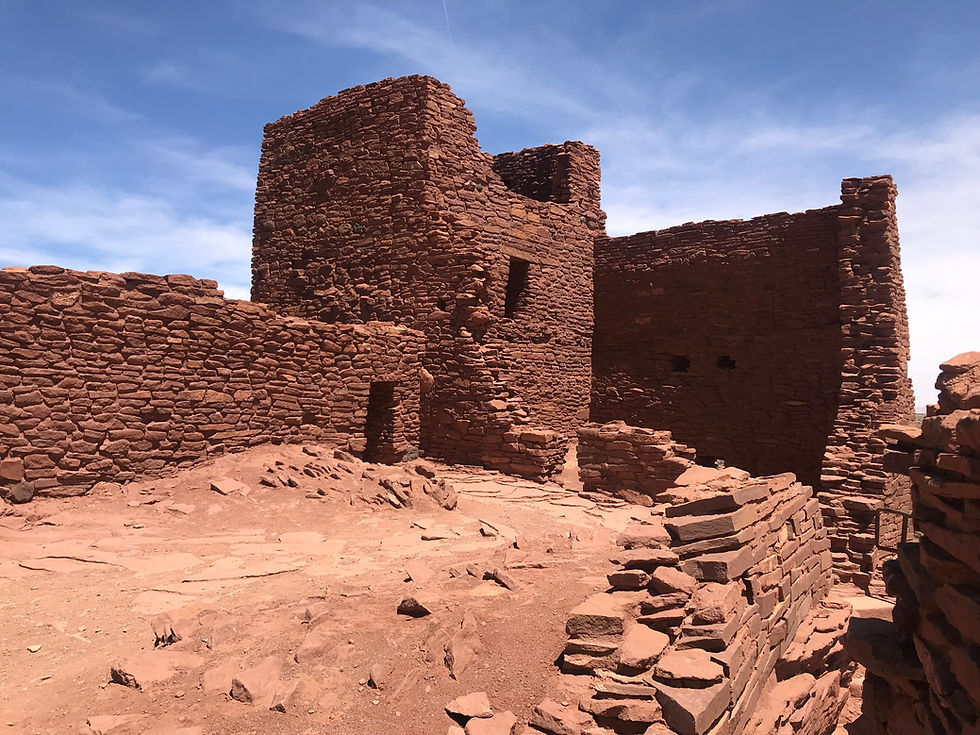


Wupatki National Monument north of Flagstaff preserves over 2,700 ancient sites across 55 square miles of painted desert — centered on the 104-room Wupatki Pueblo, the northernmost ball court ever discovered, a geological blowhole that breathes with the earth's pressure, and five accessible pueblos built from the distinctive red Moenkopi sandstone of the Colorado Plateau.
National & State Parks
Ancient Ruins

Exploring
America the Beautiful pass accepted for day use

Cell service may be limited — download maps before you go
No camping — day use only
No pets allowed on site
Water: Bring your own — no water on trails
More Info
Plants Foraged
Nearby Locations
Navajo Moenave Dinosaur Tracks

Homolovi State Park

Petrified Forest National Park

Two Guns

Lava River Cave

Wupatki National Monument
Twenty miles north of Flagstaff, the landscape opens into something that doesn't quite look like the rest of Arizona. Painted desert rolling to the horizon. Red sandstone formations rising from volcanic cinder fields. And scattered across it all — multistory stone pueblos that have been standing here for nearly a thousand years, weathered the same color as the rock they were built from.
Wupatki, which means "Long Cut House" in the Hopi language, is a multistory pueblo dwelling comprising over 100 rooms and a community room and the northernmost ballcourt ever discovered in North America, creating the largest building site for nearly 50 miles.
We visited on April 2, 2018 — with my sister's family including four kids and my two. Seven children in the ruins of a thousand-year-old pueblo is exactly as chaotic and wonderful as it sounds. The kids went into the rooms, looked through the window openings at the landscape beyond, explored the ball court, and stood at the blowhole. The adults did the same, perhaps more slowly. My parents visited again on May 19, 2022 — photos from both visits are part of this record. Thank You Mom (LaRee) for the wonderful photos capturing Wupatki National Monument.
How Wupatki Came to Be — The Volcano Made It Possible
It started with a cataclysm. The eruption of Sunset Crater Volcano in 1085 CE bent and broke the landscape of Northern Arizona. The Sinagua people quickly moved out of the area as Sunset Crater began its eruptions. Yet just a few years later, the people came back — not to the scorched land surrounding the volcano, but to the arid region 20 miles north.
A major population influx began soon after the eruption, which blanketed the area with volcanic ash, improving agricultural productivity and the soil's ability to retain water. A period of increased rainfall followed the eruptions, and the layer of volcanic ash that had fallen added nutrients to the soil. It helped the ground absorb moisture and prevented evaporation. Dry terrain suddenly turned arable and farming communities sprang up across the plains.
Wupatki is the only known area in the Southwest where physical evidence from at least three archaeologically separate Ancestral Puebloan cultures — Cohonina, Sinagua, and Kayenta — is found together in a number of sites. The volcano brought them all here. The fertile ash-covered soil kept them.
The Pueblo — Built Into the Rock
The sprawling three-story village straddles an outcropping of sandstone. This is the detail that stood out most on our visit — the walls are not freestanding in the way you might imagine. They are built around and into existing rock formations. Large boulders appear mid-wall. Sections of wall emerge directly from natural stone outcrops. The builders used what was already there, incorporating the existing geology into the structure rather than working around it. The dwelling's walls were constructed from thin, flat blocks of the local Moenkopi sandstone, giving the pueblos their distinct red color. Held together with mortar, many of the walls still stand.
Looking through the window openings and doorways at the painted desert landscape beyond — the Painted Desert stretching to the northeast, the San Francisco Peaks visible to the south — you understand the strategic logic of this hilltop site. The view from inside the pueblo rooms looking out through those openings is one of the most memorable visual moments at any Arizona archaeological site.
By 1182, perhaps 85 to 100 people lived at Wupatki Pueblo, the largest building for at least fifty miles. Within a day's walk, a population of several thousand surrounded Wupatki.
The Ball Court
Similar ball courts are found farther south in Mesoamerican cultures, hinting at the extensive trade networks that linked Wupatki to other regions. Items found here, such as shell jewelry, turquoise, copper bells, and parrot remains, are all further evidence of Wupatki's role in connecting people and goods across vast distances.
The ball court at Wupatki is the northernmost ever discovered — an oval earthen enclosure where games were played that may have lasted for days. Standing inside it and looking up at the pueblo above, you get a sense of Wupatki as a living community hub rather than just a dwelling. People gathered here. They played, competed, traded, and exchanged ideas from cultures hundreds of miles apart.
The Blowhole — The Breathing Earth
There is also a natural blowhole at the pueblo right across from the ball court, which many Indigenous groups see as a connection between worlds — underworld, surface, and sky. Known to the Hopi as Huukyangwuy Kii'at, or wind's home or breath from the mountains, Hopi elders suggest that the blowhole was used to predict weather changes.
A network of small underground tunnels and chambers acts as a giant barometer, blowing air through the blowhole when the underground air is under greater pressure than the outside air. On hot days, cool air rushes out of the blowhole with amazing force.
I sit there listening to the soft freight train whoosh roaring through underground chambers and sampling that fountain of wind. More than the dwellings, signage, or artifacts, the blowhole helps me see those who resided here. I envision them after a spirited bout on the ballcourt hurrying over to this little fracture in the ground. There was probably some playful shoving as they jockeyed for position. Then smiles and laughter as they leaned over the opening taking a refreshing blast of chilled air right in the face. How miraculous it must have seemed.
The Other Pueblos — Drive the Loop
Wupatki may be the largest of the pueblos at the monument, but you'll also want to stop at the others as you drive the loop road.
Wukoki — an eight-room pueblo built on a Moenkopi sandstone pedestal at 4,600 feet, three stories high, built with sandstone and siltstone. It could have housed one or two families. The most photogenic pueblo in the monument — a square tower rising from a single rock pedestal against the painted desert sky.
Citadel and Nalakihu — important parts of the agricultural community from the early 1100s and mid-1200s. Citadel is two stories high and had 50 or more rooms — at its peak it could have housed at least 60 people. A short walk from the loop road.
Lomaki — "Beautiful house" in Hopi — situated on the edge of a collapsed earth crack. A quarter-mile trail takes visitors to Lomaki and along the way they can see small ruins at the mouth of Box Canyon. Take a closer look at the sandstone formations to see some fossils.
The Dark Sky
In 2016, Wupatki NM, along with Walnut Canyon National Monument and Sunset Crater Volcano NM, was designated an International Dark Sky Park by DarkSky International, in recognition of the quality of the star-filled night sky and commitment to reducing light pollution. No camping in the monument but the drive out after dark on the Loop Road is exceptional for stargazing.
Part of a Three-Day Loop
Our April 2, 2018 visit was part of a three-day northern Arizona loop that also included Lava River Cave, Sunset Crater Volcano National Monument, Twin Arrows Trading Post, Two Guns, Homolovi State Park, Winslow, Holbrook, and Petrified Forest National Park. Wupatki and Sunset Crater are connected by the 36-mile Loop Road — visiting both in a single day is the standard approach and the most rewarding way to experience this volcanic and archaeological landscape together.
More Information (2026)
Entrance fee: $25/vehicle — valid 7 days, covers both Wupatki and Sunset Crater Volcano
Visitor Center: museum, bookstore, restrooms, water — no other water available on the loop
All pueblo trails are short — Wupatki main trail 0.5 miles round trip, Wukoki 0.25 miles, Lomaki 0.5 miles, Citadel 0.2 miles
Blowhole: located at the base of the Wupatki Pueblo near the ball court — free to visit as part of the main trail
Guided hikes available November–March on Saturdays — reservation required, begin at noon, 2–3 hours
International Dark Sky Park — exceptional stargazing after dark on the Loop Road
November through March guided Saturday hikes — reservation required at Visitor Center
Contact
Wupatki National Monument
25137 N. Wupatki Loop Road, Flagstaff, AZ 86004
(928) 679-2365 nps.gov/wupa
Hours (2026) Visitor Center: 9:00 AM–5:00 PM daily
Loop Road: Open 24 hours — vehicle access may be restricted in severe weather
#WupatkiNationalMonument #SinaguaPeople #AncestralPuebloans #Flagstaff #PaintedDesert #Blowhole #BallCourt #ArizonaHistory #NationalMonument #AZPlaces #CoconinoCounty #AncientRuins #WukokiPueblo #DarkSkyPark #NorthernArizona
Arizona
Loop Rd, Flagstaff, AZ 86004, USA

Coconino County
35°31'12.7"N 111°22'17.0"W
Elevation: 4,900 feet
Directions
From Flagstaff, AZ: Head north on US-89 approximately 14 miles from downtown Flagstaff. Turn right at the signed entrance to Sunset Crater Volcano / Wupatki Loop Road. Follow the 36-mile loop road northeast through Sunset Crater Volcano National Monument — the Wupatki Visitor Center and main pueblo are approximately 19.5 miles from the Sunset Crater Visitor Center at the south entrance. Alternatively enter from the north off US-89 — the Wupatki Visitor Center is 13 miles from the northern Loop Road entrance. (~30 miles north of Flagstaff via the north entrance on US-89)


Best Seasons & Temperatures
Spring and fall are the ideal seasons — mild temperatures, comfortable conditions for the exposed loop road stops and open pueblo trails. April is excellent — wildflowers in the painted desert and comfortable hiking temperatures. Summer heat on the exposed mesa can be extreme despite the 4,900-foot elevation — go early morning and carry significant water. Winter visits are possible and beautifully uncrowded — the pueblos in snow are remarkable but check road conditions. The Loop Road is open year-round weather permitting.
Wupatki National Monument Sinagua pueblo blowhole ball court Flagstaff Arizona painted desert
April 2, 2018 | May 19, 2022 (parents' visit)