AZ Places
480-485-7233
Contact@AZplaces.com
www.AZplaces.com


Camping: None at location.
Details
Spring
Mid February through Late April
Dry Summer
May and June
Wet Summer
July through September
Fall
October through Mid December
Winter
Late December through Late February
Best Seasons
Nearest Hospital
Nearest Convenience Store

Aztec Ruins National Monument
New Mexico
725 Ruins Rd, Aztec, NM 87410
San Juan County
Elevation: 5,646 feet
Directions
From Albuquerque/Bloomfield, NM: Follow Highway 550 north into the City of Aztec, turn left at the “T” intersection onto Highway 516, drive 3/4 mile, then turn right immediately after crossing the river onto Ruins Road. Follow Ruins Road 1/2 mile to the monument. From Durango, CO Follow Highway 550 south into the City of Aztec. Highway 550 will become 516. Follow 516 and turn right immediately after crossing the river onto Ruins Road. Follow Ruins Road 1/2 mile to the monument. From Farmington, NM Follow Highway 516 east into the City of Aztec. 1/4 mile past Lightplant Road, turn left onto Ruins Road. Follow Ruins Road 1/2 mile to the monument.
Exploring
Aztec Ruins National Monument
Aztec Ruins National Monument in Aztec, New Mexico preserves one of the best-preserved Ancestral Puebloan great house complexes in the American Southwest — a UNESCO World Heritage Site featuring the West Ruin's 400+ interconnected rooms, original wooden ceiling beams, and the largest reconstructed Great Kiva in North America, walkable on a self-guided tour through rooms built in the 1100s.
The name is historically inaccurate and the monument acknowledges it openly — 19th-century American settlers who found these ruins assumed they must have been built by the Aztecs. They were wrong. The people who built Aztec Ruins were the Ancestral Puebloans, the same culture responsible for Chaco Canyon 60 miles to the south, Mesa Verde to the north, and the networks of great houses across the Four Corners region. They had nothing to do with the Aztec Empire of central Mexico.
Aztec Ruins National Monument lies on the western bank of the Animas River in Aztec, New Mexico — about 12 miles northeast of Farmington and an easy drive from the Four Corners area. It is a UNESCO World Heritage Site, designated as part of the Chaco Culture complex. It is listed on the National Register of Historic Places. It is one of the finest Ancestral Puebloan sites accessible to visitors in the American Southwest.



The West Ruin — The Great House
Construction at Aztec began around the late 1000s CE and continued through the 1100s and into the 1200s. The ancestral Pueblo people chose this location in the Animas River Valley deliberately — the river provided reliable water for farming and the terrace overlooking it provided the strategic high ground for a planned community of considerable ambition.
The West Ruin — the primary structure visitors explore on the self-guided tour — has at least 400 interconnected rooms across three stories, with some walls reaching 30 feet in height. The scale of it is not immediately apparent from outside. Once you step into the interior room sequence and begin moving through the spaces — doorways aligned along sight lines, rooms stacked above and beside each other in a precisely planned configuration — the engineering sophistication of the builders becomes clear.
The original pine, spruce, and aspen ceiling beams are still in place in many rooms — preserved by the dry climate of the San Juan Basin for nearly a thousand years. Standing beneath them is a genuine connection to the people who placed them there.
The Great Kiva
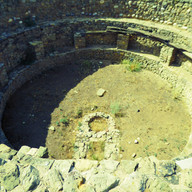
The Great Kiva of the West Ruin Plaza is the monument's most remarkable feature — the oldest and largest reconstructed Great Kiva in North America. Kivas are ceremonial and community gathering spaces, typically circular and partially or fully subterranean. The Great Kiva at Aztec is 48 feet in diameter and was restored between 1933 and 1934 by Earl Morris, the archaeologist who spent much of his career excavating and studying the Aztec site.
Standing inside the restored Great Kiva — the massive wooden roof posts, the fire pit at the center, the surrounding bench and the antechambers off the main floor — gives a more immediate sense of what Ancestral Puebloan community life felt like than almost any other accessible site in the Southwest. The space was clearly designed for gathering, ceremony, and shared experience at a scale that speaks to a significant and organized community.
The walk through the Great House and the Great Kiva was one of the highlights of the visit. The intricate masonry, the sense of the rooms as lived spaces rather than ruins, and the scale of what the builders accomplished without modern tools or machinery is genuinely striking.
The Hubbard Site
A short walk from the West Ruin is the Hubbard Site — one of only a handful of tri-walled structures in the entire Southwest. The tri-walled structures at Aztec are among the most architecturally unusual features of any Ancestral Puebloan site. Their purpose is not fully understood — ceremonial use is the leading interpretation.
Connection to Chaco
Aztec Ruins is directly connected to Chaco Culture — the regional system of great houses, roads, and ceremonial infrastructure that defined the Ancestral Puebloan world from approximately 850 to 1150 CE. Chaco Canyon sits 60 miles to the south. The roads connecting Chaco to its outlier communities — including Aztec — are still traceable in aerial photography today. Aztec was one of the most significant outlier communities in the Chaco system and later became an independent center of Ancestral Puebloan culture as Chaco declined.
Both sites are part of the same UNESCO World Heritage designation — visiting Aztec with Chaco in mind, or better, visiting both in sequence, makes each more meaningful.
The Visitor Center and Museum
The visitor center includes a museum with artifacts recovered from the site — food remains, stone and wood tools, cotton and feather clothing, fiber sandals, and jewelry made of turquoise and shells. The context these objects provide for the self-guided tour through the ruins is significant. Plan 30 minutes in the museum before walking the site.
Ranger talks are offered daily at 10:30 AM and 2:30 PM during summer months. The self-guided tour through the West Ruin takes approximately one hour.
See the National Park Service for more details.