

Banana Yucca
✓ Edible
✓ Medicinal
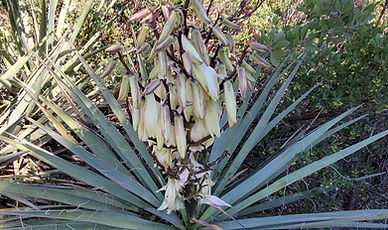
Yucca baccata
Plant Family: Asparagaceae (Agave / Asparagus Family) — formerly Agavaceae
Other Names
Blue Yucca, Datil Yucca, Spanish Bayonet — Spanish: Datil — Navajo: Tsá'ászi' — O'odham: Amol
✓ None
⚠ High
⚠ Moderate
⚠ Low
Fruit (raw, baked, dried cakes), Flowers (raw, cooked), Flower stalk (emerging, cooked), Seeds (ground flour), Roots
Edible Parts


How to Identify
This yucca was named for its edible, banana-shaped fruit. The plant grows slowly to three to five feet tall and wide with large, strap-like, dark-green foliage that is stiff, erect, sharply pointed, and arranged spirally at the base of its stem. This plant also produces white fibers along its leaf margins that tend to curl on the plant.
Size & Form: A low-growing, stemless or short-stemmed rosette plant — rarely taller than 3–5 feet. The leaves radiate outward from the base in a dense, spiraling rosette. Older plants may develop a short, woody trunk. Known from the Great Basin, the Mojave, Sonoran, and Chihuahuan Deserts, plus the Arizona/New Mexico Mountains ecoregion.
Leaves: Large, strap-like, dark-green foliage that is stiff, erect, and sharply pointed. Leaves are 1–3 feet long and about 1–2 inches wide, concave on the upper surface. The leaf margins have white, curling fibers — a distinctive and easy identification feature. The terminal spine is needle-sharp and capable of penetrating skin with significant force. Approach with respect.
Flowers: In spring the plant sends up tall flower stalks from a center whorl of leaves. The flowers are creamy white, bell-shaped and appear in thick clusters. The flower stalk can reach 3–5 feet tall. The bell-shaped white to cream flowers hang in dense, showy panicles and are strongly fragrant.
Fruit: The fruit is the most distinctive feature — banana-like fruit that contains flat, black seeds. Typically 3–5 inches long, fleshy, initially green ripening to brown or purplish with spots of sugar fermentation visible on the skin. When ripe, brown spots of sugar fermentation will be notable on the skin's light green surface. The fruit resembles a stubby banana — nothing else in the Arizona landscape produces it.
White Leaf Fibers: The curling white fibers along the leaf margins are a key field identification feature — no other common Arizona plant produces this exact combination of rigid pointed leaves with white marginal fibers.
Distinguishing from Other Yuccas: Yuccas can be distinguished from agaves by their thin leaves which are semi-succulent to non-succulent, as opposed to the fatter succulent agave leaves. Also yuccas send up stalks almost every year while agaves produce a stalk only once then die. Among Arizona yuccas, the large fleshy banana-shaped fruit is unique to Yucca baccata.
Where and When to Gather
Grassland
Desert
Forest
Habitat: Rocky slopes, canyon edges, desert grasslands, pinyon-juniper woodland, and lower mountain forest zones. Arizona is the center of greatest distribution for this Yucca and population densities in other states are greatest in proximity to Arizona.
Elevation: 3,000 to 7,000 feet in Arizona — primarily in the mid-elevation transition zone between desert and forest. Found in the Pinal Mountains, Mazatzals, White Mountains, Mogollon Rim foothills, and mountain ranges of southern Arizona.
Range: Found in Colorado, Utah, Nevada, California, Arizona, New Mexico, and Texas. Also found in Sonora, Chihuahua, and Coahuila, Mexico. Widespread across Arizona's mid-elevation zones.
When to Gather:
Emerging flower stalk: Spring — harvest before flowers open, when stalk is still tender and compact
Flowers: Spring — gather during peak bloom, creamy white bells still fresh
Fruit: The fruits were often picked before maturity and ripened off the plant to keep wildlife from eating them first. Late spring through summer — fruit forms after flowering and ripens June through August depending on elevation Wanderer Writes
Seeds: Summer through fall — from ripe or dried fruit
Elevation Range: 3,000 to 7,000 feet in Arizona
Seasons
Spring
Dry Summer
✓ Seen / Harvested
Found Banana Yucca at the Pinal Mountains on May 2024 — fruit was present but still unripe at that point in the season, so did not harvest. The mid-May timing at that elevation puts fruit just ahead of the harvest window — late June through July would likely be the right time to return to the same plants. A good reminder that knowing where a plant grows is half the work — the timing is the other half.
May, 3 2026 Chiracachua Mountains - Appeared most the fruit was past its time.
September 2026 harvested fruit directly off Highway 17 near Stoneman Lake.
Chiricahua Mountains

Jacks Canyon (FR 230)

Pinal Mountains

Walnut Canyon National Monument

How to Gather
⚠️ Arizona Salvage and Harvest Restricted — See Conservation Status section before harvesting.
Fruit — The Priority Harvest:
Monitor plants after flowering — fruit develops through late spring and early summer
Pick before full maturity and ripen off the plant to beat wildlife to the harvest Wanderer Writes
Ripe fruit is indicated by brown spots of sugar fermentation on the skin's surface Ghosttownaz
Twist fruit gently from the stalk — it should come away without resistance when ripe
Wear long sleeves and be mindful of the sharp leaf tips when reaching into the rosette
Process or dry immediately — fresh fruit does not keep long
Flowers:
Gather clusters of fresh white bell flowers during peak bloom
Use gloves — the leaf tips surrounding the flower stalk are needle-sharp
Best gathered in the morning — fresh and fully open
Use raw or cook immediately — flowers do not dry well
Emerging Flower Stalk:
Harvest the central flower stalk in spring before flowers open — when it is still compact and tender, emerging from the leaf rosette
Cut at the base with a sharp knife — wear gloves and be careful of leaf spines
The stalk is at its best before it elongates — once it begins to extend the texture becomes tougher
HOW TO USE
Edible Uses
Flowers, flower stalks, seeds, and squash-like fruit are edible, raw or cooked. The fruit of the Banana Yucca was especially favored.
Fruit: The fruit of the Banana Yucca can be used as a substitute for apples. When the fruit is baked it has a flavor similar to potatoes. Raw fruit is mildly sweet and starchy — improved significantly by cooking. The cooked fruit is dense, sweet, and filling.
Flowers: Young flowers are also edible and taste like asparagus. One of the best flavor descriptions in desert foraging — the young flowers have a genuine vegetable character. Eat raw in salads or cook briefly.
Emerging Flower Stalk: The young emerging stalk, harvested before flowering, can be roasted or boiled and eaten like asparagus. Rich in carbohydrates and starchy — a substantial wild food. Must be cooked to break down saponins.
Dried Fruit Cakes: The pulp from the fruit was, after cooking, often pounded and sun-dried, then shaped into cakes that could be stored for winter use. One of the most important traditional preserved foods of the Southwest — a food storage solution that kept through winter.
Seeds: The seed pods could be eaten raw but were generally roasted, ground, and kneaded into small sun-dried cakes. Dried fruits dissolved in water to make a drink.
Medicinal Uses
Yucca produces several therapeutic effects mainly through its influence on intestinal tract membranes and related flora. The plant's saponins form complexes with abnormal colonic flora by-products rendering these toxins to some degree inert. Since these saponins are indigestible, the formed complexes are removed with other waste matter from the colon. Therefore bacterial end-products are unable to exert an inflammatory effect because they literally are stuck to Yucca's saponins, making absorption into systemic circulation less likely.
Anti-inflammatory / Arthritis: Yucca saponins are one of the most studied natural anti-inflammatory compounds. Widely used in folk and herbal medicine for arthritis, joint inflammation, and rheumatic conditions. Several clinical studies have supported modest efficacy.
Digestive Health: The saponin content supports healthy gut flora balance and reduces intestinal toxin absorption — a genuine prebiotic and gut health effect.
Root Soap / Hair Care: The Tohono O'odham and Pima pounded the leaves in water to form a lather used to wash hair. The saponins produce a conditioning, foaming cleanser — traditionally used to strengthen and clean hair. Still used today in natural hair care.
Wound Poultice: Leaf pulp and root preparations applied topically for wounds, skin inflammation, and minor infections.
Native American Uses
Almost all parts of the Banana Yucca are used including stalks, leaves, flowers, fruits, and roots. The plant provides food sources including beverages, cakes, sauces, relishes, preserves, and porridges — materials are also obtained and used for sporting items and ceremonial objects.
Apache: Fruit roasted, pulp made into cakes and stored. Leaves used for the main portion of baskets. White Mountain Apache used roots for soap.
Acoma: Dried fruits dissolved in water to make a drink. Fruits baked, boiled, dried, rolled into loaves and stored for winter use.
Havasupai: Leaf fiber braided into ropes. Utilized the banana yucca fruit — other groups including Havasupai, Hopi, Navajo, Pima, Yavapai, and Zuni all used the fruit.
Navajo: Fruit eaten fresh and dried into cakes. Leaf fibers woven into baskets, sandals, and rope. Roots used for ceremonial hair washing — a practice still continued today at traditional Navajo ceremonies. Yucca root shampoo is used in traditional Navajo puberty ceremonies (Kinaaldá) to wash the young woman's hair.
Tohono O'odham and Pima: Pounded the leaves in water to form a lather for washing hair. The Pima broke up the leaves to pull out individual fibers used to make hair brushes, ropes, cordage for bundles, and floor mats.
Fiber Uses (Multiple Nations): Banana Yucca is preferred over other yuccas because of the strength of its fibers. Individual fibers from yuccas were produced by soaking leaves in water then pounding them with wooden clubs on flat rocks. After rinsing away the softened pulp, the remaining fiber filaments were twisted together into threads. Yucca fiber and threads were used to construct sandals, ropes, mats, clothing, nets, hairbrushes, mattresses, and baskets.
Needle and Thread: With the fleshy leaf tissue removed the remaining stiff fibers can be made into a combination needle and thread — the terminal leaf spine serves as the needle, and attached leaf fibers as the thread. A complete sewing tool from a single leaf.
How to Prepare | Recipes
Baked Banana Yucca Fruit
Harvest fruit when ripe — brown sugar spots visible on green skin, yields slightly to pressure
Rinse thoroughly
Place whole fruits directly in a bed of coals or in a 350°F oven
Roast 45–60 minutes until skin is charred and interior is soft
When baked the fruit has a flavor similar to potatoes — starchy, mildly sweet, dense
Peel away charred skin — eat the soft interior flesh
Season with salt, butter, or honey
Traditional Sun-Dried Yucca Cakes
Harvest ripe fruit — gather as much as available
After cooking, pound the pulp in a mortar or food processor until smooth
The sweet juice that drains during pounding is delicious — drink or pour over cakes
Shape the pounded pulp into flat cakes — approximately half an inch thick
Sun-dry the shaped cakes on a clean rack in full sun for 2–3 days until completely dry and firm
Store in a cool dry place — dried cakes will keep for a very long time
To use: rehydrate in water or cook directly in soups and stews
Yucca Flower Sauté
Gather fresh white bell flowers during peak spring bloom
Rinse gently
Heat olive oil or butter in a pan over medium heat
Add flowers and a pinch of salt — sauté 3–5 minutes until just wilted
Young flowers taste like asparagus — serve as a vegetable side dish
Add garlic, lemon, and pepper to taste
Also good added raw to salads for color and mild flavor
Yucca Root Shampoo
Dig a section of root from a plant — use sparingly and only where permitted
Pound or chop the root into small pieces
Pound the root pieces in water to form a lather — the saponins create genuine foam
Use as a shampoo — massage into wet hair, work into a lather, rinse thoroughly
The saponin lather is conditioning and cleansing — a genuinely effective natural shampoo
Cautions
⚠️ Arizona Salvage Restricted AND Harvest Restricted — confirm regulations with the Arizona Department of Agriculture before harvesting any part of the plant.
Leaf terminal spines are needle-sharp and capable of serious injury — approach plants carefully, wear protective clothing, and never walk backward into a Yucca rosette.
Raw flower stalk and roots contain saponins — to render yucca stems edible saponins must be broken down by baking or boiling. Always cook stalks and roots thoroughly before eating.
Saponins in large quantities can cause digestive upset — consume cooked preparations in reasonable quantities and assess tolerance.
Root preparations for internal use should be approached with caution and limited quantity — saponins are powerful compounds.
No toxic look-alikes — the banana-shaped fleshy fruit is unique and unmistakable. Note: soap tree yucca (Yucca elata) fruit is not edible — know your species.
Do not harvest from protected lands without a permit.
⚠️ DISCLAIMER This information is provided for educational purposes only. Always positively identify any plant before consuming or using medicinally. When in doubt, do not harvest. Consult a qualified healthcare provider before using any plant for medicinal purposes. Some plants have toxic look-alikes — never rely on a single source for identification. AZ Places and Rachel Joel assume no responsibility for misidentification or misuse.


