
Creosote Bush
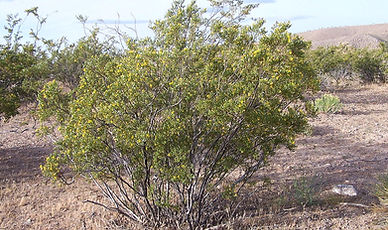
Larrea tridentata
Other Names: Greasewood, Chaparral, Hediondilla, Gobernadora, Guamis — Tohono O'odham: Shegoi — Navajo: Dįį' łichíí' — Pima: Oam Bagaj
Plant Family: Zygophyllaceae (Caltrop Family)
Edible Parts: Flowers, Resin (historical), Seeds (limited)
Elevation Range: Below 5,000 feet
How to Identify
Creosote Bush is one of the easiest desert shrubs to identify once you know it — and the smell alone will confirm it.
Size & Form: An evergreen shrub typically 3–6 feet tall, occasionally reaching 10–12 feet. Multiple woody stems grow from a central base, spreading outward in an open, airy form. Older plants develop a distinctive ring-shaped clonal colony — a single plant that has cloned itself outward over thousands of years. The oldest known Creosote colony in the Mojave Desert, called "King Clone," has been dated at approximately 11,700 years old — one of the oldest living organisms on earth.
Leaves: Tiny, paired, resinous leaves — usually less than half an inch long. Dark olive-green to yellow-green, waxy and shiny. The waxy coating contains powerful aromatic compounds including nordihydroguaiaretic acid (NDGA).
Flowers: Small, bright yellow, five-petaled flowers. Appear most profusely in spring but can bloom multiple times per year following rainfall.
Fruit: Small, round, fuzzy white or grey seed capsules that split into five segments when mature. Covered in silky white hairs — distinctive and easy to spot.
The Smell — The Best Identifier: Creosote Bush produces one of the most distinctive and beloved scents of the desert Southwest. When wet from rain, the waxy resin on the leaves volatilizes and produces a powerful, earthy, camphor-like scent — what many desert dwellers call "the smell of rain." You can replicate this by cupping a handful of leaves in your palms and blowing warm breath on them. If it smells unmistakably like the desert after a rainstorm, you have Creosote Bush.
Where and When to Gather
Habitat: Desert scrub, dry plains, mesas, rocky bajadas, and valley floors. One of the most drought-tolerant perennial plants in North America.
Elevation: Below 5,000 feet. Most abundant below 3,000 feet in the lower Sonoran Desert.
Range in Arizona: Extremely widespread — found across most of Arizona's lower desert counties including Maricopa, Pima, Pinal, Yuma, La Paz, Mohave, and Yavapai. One of the most common and abundant shrubs in the Sonoran Desert.
Also Found: Mojave Desert (California, Nevada, southern Utah), Chihuahuan Desert (New Mexico, west Texas, Mexico).
When to Gather:
Leaves and Twigs: Best gathered in late spring or early summer when volatile oil content peaks. Young growth is most potent. Can be gathered year-round but peak potency is spring.
Flowers: Gather in spring during peak bloom — or after any significant rainfall triggers blooming.
Fruit/Seeds: Gather when the white fuzzy capsules appear after flowering.
Wet Summer
Dry Summer
Spring
How to Gather
Creosote Bush is extremely abundant and considered resilient — light harvesting has minimal ecological impact when done responsibly.
Gather leaves and small green twigs by hand — no tools needed
Take small amounts from many plants rather than stripping one plant heavily
Avoid harvesting more than 10–15% of any individual plant's foliage
Gather from plants away from roadsides and areas with potential chemical contamination
Best harvested on a dry day — wet plants are harder to dry properly
For drying: spread leaves and small twigs on a clean surface in a warm, well-ventilated area out of direct sun. Store in glass jars away from heat and light.
How to Use
Edible Uses
Creosote Bush is primarily medicinal rather than edible. Edible uses are limited and should be approached carefully — see Cautions section.
Flowers: Can be eaten raw or used to make a light tea. Mildly aromatic.
Resin (NDGA): Historically used as a natural food preservative — NDGA was widely used in the US food industry in the 1940s and 1950s before being removed from the FDA's GRAS list. Not recommended for home use.
Creosote honey: In areas where bees work Creosote flowers, the resulting honey has a distinctive aromatic, complex flavor considered a specialty product in some Southwestern communities.
Medicinal Uses
Creosote Bush is arguably the most important medicinal plant in the Sonoran Desert — used to treat more conditions than virtually any other desert plant. Its primary active compound is nordihydroguaiaretic acid (NDGA), a potent antioxidant and anti-inflammatory agent.
Documented and Traditional Uses:
Antimicrobial / Antifungal: Topical application for cuts, wounds, skin infections, burns, and fungal conditions. One of the most validated uses — antimicrobial properties confirmed in modern research.
Anti-inflammatory: Leaf tea and steam baths used for arthritis, rheumatism, and musculoskeletal pain. NDGA has demonstrated anti-inflammatory properties in laboratory studies.
Respiratory: Leaf tea or steam inhalation for colds, bronchitis, chest congestion, sinusitis, and asthma.
Digestive: Tea used for stomach cramps, diarrhea, intestinal discomfort, and nausea.
Analgesic: Decoction used as a wash for sore muscles and aching joints.
Antioxidant: NDGA is one of the most potent naturally occurring antioxidants known — studied for potential cancer-preventive and longevity-promoting properties.
Kidney Stones: Traditional use for dissolving gallbladder and kidney stones — not clinically validated but widely reported in ethnobotanical literature.
Preparations:
Tea: Dry leaves and small twigs, steep in hot (not boiling) water for 10–15 minutes. The tea is bitter and strongly aromatic. Traditionally consumed in small quantities.
Poultice: Fresh or rehydrated leaves applied directly to wounds, skin infections, or sore joints.
Steam Bath: Boil leaves in water and inhale steam for respiratory congestion.
Salve: Infuse dried plant material in oil over low heat for several hours, strain, and mix with beeswax for a topical antimicrobial salve.
Native American Use
Creosote Bush holds profound significance in the cultures of numerous Indigenous peoples of the American Southwest — used medicinally, spiritually, and practically for thousands of years.
Tohono O'odham: Considered Creosote a sacred plant. In their cosmology, Earth Maker took soil from his breast, scattered it about, and the first plant to grow was Creosote. Used leaves as steam baths and poultices for arthritis, rheumatism, and musculoskeletal pain. Applied topically for wounds and skin irritations.
Pima (Akimel O'odham): Pulverized and steeped leaves into tea for colds, fevers, ulcers, and digestive problems. Chewed plant gum as an antidysenteric and intestinal antispasmodic. Inhaled smoke from burning Creosote leaves for respiratory relief.
Apache: Used for rheumatism and kidney stones, preparing salves and infusions. Valued the plant's resin as a natural adhesive and sealant.
Navajo: Used leaf tea for respiratory conditions and as an analgesic wash for body pain.
Hualapai: Infusion of leaves taken for respiratory aid. Leaves steamed for congestion and asthma. Infusion used as a disinfecting skin cleanser.
Diegueno: Decoction of leaves used as a bath for rheumatism and painful arthritis.
Coahuilla: Infusion of leaves taken for bowel complaints and digestive conditions.
Seri: Smoked insect galls from Creosote branches. Used plant resin (lac) as a waterproof sealant for pottery, canteens, and baskets, and as an adhesive.
Lac / Resin Uses (Multiple Nations): The sticky lac secreted by the scale insect Tachardiella larreae that lives on Creosote stems was used by desert peoples as a waterproof sealant, adhesive, and wood treatment.
How to Prepare / Recipes
Basic Creosote Tea
Gather 1–2 teaspoons of fresh or dried Creosote leaves and small green twigs
Bring water to just below boiling — high heat degrades volatile compounds
Steep leaves and twigs for 10–15 minutes
Strain and drink in small quantities — start with half a cup
The tea is strongly bitter and aromatic — an acquired taste
Traditionally used for colds, respiratory congestion, and stomach complaints
Creosote Salve (Topical Antimicrobial)
Fill a small glass jar loosely with dried Creosote leaves and twigs
Cover completely with olive oil
Infuse in a warm place or use a double boiler on very low heat for 4–6 hours
Strain plant material — discard solids
Melt 1 oz beeswax per cup of infused oil over low heat
Pour into small containers and allow to set
Apply topically to cuts, scrapes, minor infections, or dry cracked skin
Do not use on deep wounds without medical supervision
Creosote Steam Inhalation
Bring a pot of water to a boil
Add a generous handful of fresh or dried Creosote leaves
Remove from heat, drape a towel over your head and the pot
Inhale steam slowly for 5–10 minutes
Traditionally used for chest congestion, colds, and sinus pressure

Cautions
Internal use caution: Creosote tea should be consumed in small quantities only. Long-term or heavy internal use has been associated with liver and kidney toxicity in case reports. The FDA removed NDGA from its GRAS list in the early 1960s due to toxicity concerns. Consult a qualified healthcare provider before using internally.
Not for pregnant or nursing women: Avoid internal use during pregnancy — Creosote has historically been used to stimulate delayed menstruation.
Kidney and liver conditions: Those with existing kidney or liver conditions should avoid internal use entirely.
No toxic look-alikes in Arizona — Creosote Bush is distinctive and not easily confused with toxic plants when the smell test is applied. Always confirm identification before harvesting.
Topical use is generally considered safe for most people — test on a small skin area first as some individuals may experience contact sensitivity.
Do not harvest from roadsides — roadside plants accumulate vehicle exhaust and chemical runoff.