
Montezuma Castle National Monument
AtoZ Places Bucket Location


Abandoned & Ghost Towns

Ancient Ruins

Caves

Desert

Forest

Historical

Hot Springs

Lakes & Rivers

National & State Parks

Peaks


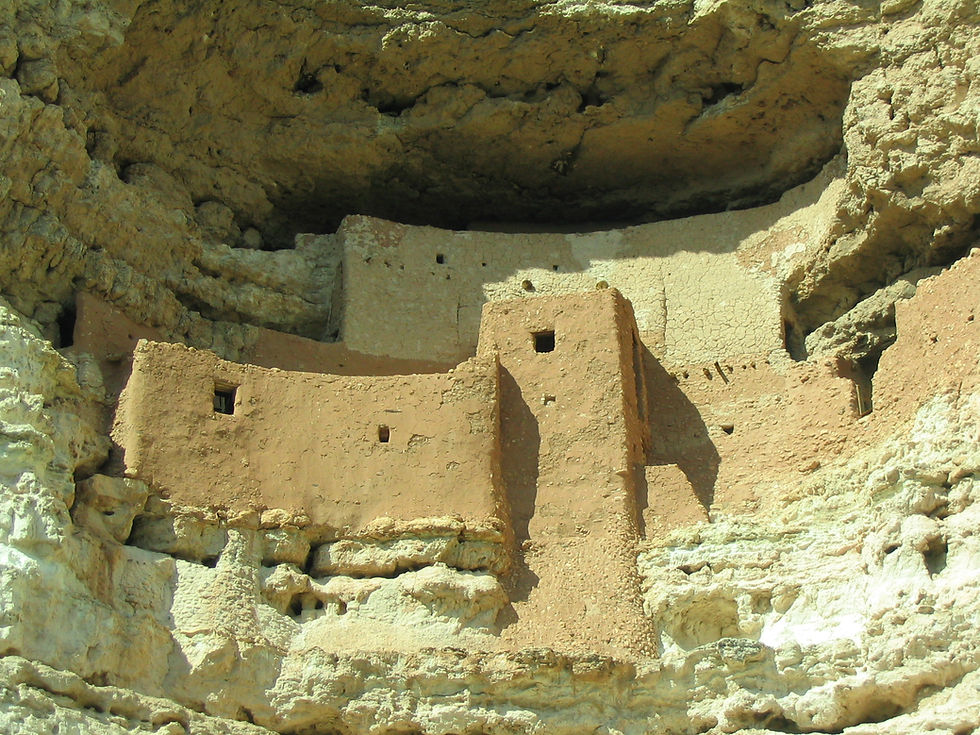


Montezuma Castle National Monument near Camp Verde preserves one of the best-preserved prehistoric cliff dwellings in North America — a five-story, 20-room Sinagua apartment complex notched 90 feet up a limestone cliff above Beaver Creek, designated in 1906 as one of America's first four national monuments and still as remarkable today as when Theodore Roosevelt first protected it.
National & State Parks
Ancient Ruins

Wildlife

Exploring

Hiking
America the Beautiful pass accepted for day use
No camping — day use only

Pets not permitted — leashed dogs allowed in parking areas and paved roads only
Picnic area with tables
Restrooms available
Water: Available at this site.
More Info
Plants Foraged
Manzanita

Nearby Locations
Montezuma Well

Tuzigoot National Monument

Dead Horse Ranch State Park

Palatki Heritage Site

Montezuma Castle National Monument
Some places earn repeated visits across a lifetime. Montezuma Castle is one of them — a site we have brought grandparents, children, and grandchildren to across nearly four decades. Each generation stands at the same viewing point on the short loop trail, looks up at the same five-story cliff dwelling 90 feet above Beaver Creek, and has the same moment of quiet astonishment. The castle does not change. The people who come to see it do.
Four visits across our family's history — sometime in the late 1980s or 1990s with Glen, March 2009 when Alexis visited with grandparents, 2014 when Luca visited with grandparents, and May 20, 2022 when my parents visited. This site has been part of our family's Arizona experience across multiple generations now.
The Misnomer — Not Aztec, Not Montezuma
The name Montezuma Castle is a complete historical error — and the monument's own interpretation acknowledges it clearly. Early Anglo settlers in the Verde Valley in the 1800s assumed the elaborate cliff dwelling must be connected to Aztec history and named it after the Aztec emperor Montezuma II. The structure has no connection to the Aztecs whatsoever — Montezuma II never came within a thousand miles of central Arizona. The builders were the Sinagua people, a pre-Columbian culture who lived in the Verde Valley from approximately 600 CE to 1425 CE. Several of today's Hopi clans trace their ancestry to the Sinagua.
The Dwelling — 800 Years and Still Standing
Montezuma Castle is situated about 90 feet up a sheer limestone cliff, facing the adjacent Beaver Creek, which drains into the perennial Verde River just north of Camp Verde. It is one of the best-preserved cliff dwellings in North America — in part because of its ideal placement in a natural alcove that protects it from exposure to the elements above and the creek below.
The five-story, 20-room structure was built using a combination of adobe, stone, and wooden beams between 1100 CE and 1350 CE. Historians believe Sinagua women built the structures. The precariousness of the dwelling's location and its immense scale across five stories suggest the Sinagua were daring builders and skilled engineers. Access into the structure was most likely permitted by a series of portable ladders — which made it extremely difficult for enemies to penetrate the natural defense of the vertical limestone barrier.
At its peak the castle may have housed approximately 35 to 50 people. It was part of a broader Sinagua occupation of the Verde Valley — a trading center used by dozens of Native tribes, connected to Pueblo cultures to the north and Apache cultures to the south. Shell jewelry, turquoise, copper bells, and parrot remains found in the area speak to trade networks reaching from the Pacific Coast to central Mexico.
For mysterious and unknown reasons the Sinagua abandoned Montezuma Castle and the Verde Valley in the 1400s. They did not disappear — the descendants of the Sinagua are present today in several Hopi clans who trace their ancestry to the Verde Valley people.
The Monument — One of America's First
On December 8, 1906, President Theodore Roosevelt used the newly signed Antiquities Act to designate Montezuma Castle as a national monument — one of the first four national monuments in the United States. Roosevelt identified it as a place "of the greatest ethnological value and scientific interest." By the time it received federal protection, treasure hunters and looters had already damaged the structures and stolen many artifacts. The monument was established partly in response to that loss — to ensure what remained would be preserved.
Visitors were once allowed to climb ladders and enter the dwelling. Access to the interior has been restricted since 1951 to preserve its integrity. The exterior view from the loop trail is remarkable enough.
The Trail and Visitor Center
A short 1/3-mile paved loop trail winds from the visitor center through a sycamore-lined riparian landscape along Beaver Creek to the viewing area below the castle. The trail is wheelchair accessible and suitable for all ages and fitness levels. Interpretive signs along the route explain the history, culture, and ecology of the site.
Start in the visitor center before walking the trail — exhibits of pottery, tools, and jewelry provide the cultural context that makes the dwelling itself more meaningful. The gift shop carries books on the Sinagua people, local Native American crafts, jewelry, pottery, and standard souvenirs.
Morning and late afternoon light hits the dwelling at the best angles for photography — the limestone cliff glows warm in directional light and the shadows in the alcove recede to reveal the structure's detail.
Beaver Creek and the Sycamores
The loop trail follows Beaver Creek — a perennial stream fed by springs above Camp Verde. The sycamore trees lining the creek are large and old, creating a shaded canopy that makes the walk comfortable even in warmer months. Hawks work the airspace above the creek. Lizards move along the trail edges. The lush riparian corridor in contrast to the dry limestone cliff above is part of what made this location so appealing to the Sinagua — the combination of water, shade, and defensible high ground in a single location.
Montezuma Well — Don't Skip It
Approximately 11 miles north of the castle is Montezuma Well — a separate unit of the monument included in the same entrance fee. A natural limestone sinkhole measuring 386 feet in diameter from rim to rim, where 1,500,000 gallons of water emerge each day from an underground spring regardless of drought conditions. Geologically similar to the sinkholes and cenotes of Florida and the Yucatan Peninsula, the Well was formed by a limestone cave that collapsed to expose its subterranean water source. The Sinagua irrigated crops from the Well using a canal system that still carries water today — 900-year-old infrastructure still functional. Worth the extra 20 minutes of driving on any Montezuma Castle visit.
More Information
Entrance fee: $10/adult (16+) — valid 7 days, also covers Tuzigoot National Monument
Montezuma Well: included in same entrance fee — 11 miles north, highly recommended addition
Trail: 1/3-mile paved loop, wheelchair accessible, suitable for all ages
No access to interior of dwelling — viewing from trail only since 1951
Visitor center: exhibits, gift shop, restrooms, water
Photography: morning and late afternoon light is best — east-facing dwelling
Contact
Montezuma Castle National Monument
2800 Montezuma Castle Road, Camp Verde, AZ 86322
(928) 567-3322
Hours (2026)
8:00 AM–5:00 PM daily
Closed Christmas Day
#MontezumaCastle #SinaguaPeople #AncestralPuebloans #CampVerde #VerdeValley #CliffDwelling #NationalMonument #ArizonaHistory #AZPlaces #YavapaiCounty #AncientRuins #BeaverCreek #MontezumaWell #ArizonaArchaeology #NationalParkService
Arizona
J568+J2 Camp Verde, AZ

Yavapai County
34°36'40.0"N 111°50'12.0"W
Elevation: 3,170 feet
Directions
From Camp Verde, AZ: Take I-17 North to Exit 289 (Montezuma Castle Road). Follow the signs approximately 2.5 miles to the monument entrance at 2800 Montezuma Castle Road.
From Sedona: Take AZ-179 South to I-17 South. Take Exit 289.


Best Seasons & Temperatures
Open year-round — one of Arizona's most consistent all-season destinations. The short paved trail and shaded sycamore corridor make it manageable even in summer heat. Spring and fall are ideal for comfortable temperatures and good photography light. Winter visits are quiet and uncrowded — the monument is open year-round except Christmas Day. Morning light on the castle is the best for photography.
Montezuma Castle National Monument Sinagua cliff dwelling Beaver Creek Verde Valley Arizona
Late 1980s or 1990s | March 2009 | 2014 | May 20, 2022