
Baker Hot Springs
AtoZ Places Bucket Location


Abandoned & Ghost Towns

Ancient Ruins

Caves

Desert

Forest

Historical

Hot Springs

Lakes & Rivers

National & State Parks

Peaks




Baker Hot Springs — also known as Crater Springs and Abraham Hot Springs — is one of Utah's most accessible and enduringly popular free hot springs, a chain of geothermal tubs fed by 180°F source water on Fumarole Butte northwest of Delta in Juab County, with three concrete soaking pools, dispersed camping nearby, and the kind of remote high desert setting that has been drawing visitors for well over a century.
Desert
Hot Springs

Wildlife

Exploring

Camping

Camping: Dispersed camping allowed up to 14 consecutive days.

Free entry — no entrance fee
No facilities on site — no water, no restrooms
More Info
Plants Foraged
Nearby Locations
Topaz Internment Camp & Museum

Tabernacle Hill Lava Tubes

Meadow Hot Springs
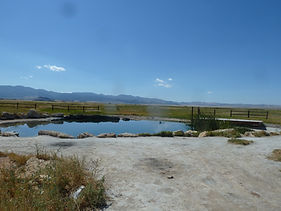
Baker Hot Springs
Baker Hot Springs sits in the open desert northwest of Delta, Utah — a chain of geothermal springs on Fumarole Butte in Juab County where water emerges from the earth at 180°F and flows into three concrete soaking pools that have been welcoming visitors since the early resort era of the American West. It is one of Utah's most reliably accessible free hot springs and one that has been part of our travel history for decades.
We have visited multiple times — first in 1995, again in November 1996, and most recently on September 21, 2017 during our month-long Southwest trip. It is the kind of place you return to.
Our Visits
1995 and November 1996 — multiple visits while living in Salt Lake City. Baker Hot Springs was a known destination during those years — accessible, free, and far enough from the city to feel genuinely remote. The high desert of Juab County in November has its own quality — the hot water against cold air, the open sky, and the silence that comes with distance from any town.
September 21, 2017
Part of our month-long Utah trip — the same journey that took us to Tabernacle Hill Lava Tubes the day before and Topaz Internment Camp nearby. We camped near the springs overnight — at the time there was one other camper in the area. That evening our fellow camper served us pancakes in the morning — the kind of spontaneous camp hospitality that makes dispersed camping in remote areas a different experience from any developed campground. He told us he had spotted a white llama that had come down from the hill to drink from the spring water. Whether it was a wayward domestic animal or something stranger we never determined.
During our 2017 visit the water was flowing well and the tubs appeared to have been recently maintained — notably less algae than we had seen on previous visits. We found an additional pool in the area beyond the main tubs that could be soaked in — worth exploring the immediate area beyond the concrete pools on any visit. There were once some abandoned buildings in the area — by 2017 these had been removed or demolished. I look forward to returning.
The Springs — What They Are
Baker Hot Springs is a geothermal feature on Fumarole Butte — a low volcanic hill in the Great Basin desert of Juab County. The water source emerges at approximately 180°F — do not enter the source pool or touch the outflow near the source. The water flows from the source through a channel system into three concrete soaking pools, each approximately 5 by 8 feet — remnants of the original resort infrastructure from the early 20th century.

Two water sources feed the pools — one delivering geothermal hot water and one delivering cold spring water — with a diversion channel allowing visitors to adjust the temperature mix in each tub. The pools are large enough to accommodate several people each. At peak condition the water is clear and the temperature manageable — but the pools are not maintained by any agency and the algae and sulfur content vary significantly visit to visit. The characteristic sulfur smell — the classic "rotten egg" of geothermal water — is present and normal.
The primary mineral content includes manganese. The discharge rate is approximately 17 gallons per second — enough to keep the pools continuously supplied with fresh water when the system is flowing well.
A small dirt road north of the parking area leads approximately 200 yards to the source of the springs — worth the short walk to see the geothermal system at its origin point. Hot water seeps in the surrounding area can be excavated by hand to create primitive additional soaking pools — the same feature we found on our 2017 visit.
Practical Notes
Clothing is optional at Baker Hot Springs — the springs are popular with residents of nearby Delta and the area is a well-known clothing-optional destination. Plan accordingly.
The springs are not maintained or cleaned by any agency — algae levels vary significantly between visits and can be heavy at times. Visit condition is unpredictable and worth accepting as part of the experience.
No facilities — no restrooms, no water, no services. Dispersed camping is available in the surrounding area — pack in and pack out everything.
#BakerHotSprings #CraterSprings #AbrahamHotSprings #UtahHotSprings #FumaroleButte #Delta Utah #JuabCounty #AZPlaces #HotSprings #DispersedCamping #FreeCamping #UtahDesert #GeothermalSprings #SoakingPools #UtahOutdoors
Dispersed Camping

Utah
Baker Hot Springs Rd, Delta, Utah

Juab County
39°36'37.9"N 112°43'49.5"W
Elevation: 4,646 feet
Directions
Baker Hot Springs is located 16 miles west of the Intermountain Power Plant near Delta. Turn towards the Intermountain Power Plant (HWY174) from US-6 just south of Lynndyl, Utah. Head west 16 to 18 miles. Turn right onto the next dirt road you come to (it's the only road to the right that has a stop sign, 16 to 18 miles west of US-6) and follow that road 7 miles. Watch for the willows off the right side of the road. From Salt Lake City, Utah take I-15 S/I-80 E from 400 S/University Blvd 4 min (1.6 mi) Follow I-15 S to State Rte 41/UT-28 S in Juab County. Take exit 228 from I-15 S 1 h 7 min (79.3 mi) Take UT-132 W and Brush Wellman Rd to Baker Hot Springs Rd h 13 min (67.6 mi)


Best Seasons & Temperatures
Baker Hot Springs is a year-round destination — the geothermal water makes winter visits particularly rewarding when the contrast between the hot water and cold air creates a classic hot springs experience. Fall and spring are the most comfortable seasons for the surrounding desert environment. Summer heat in the open high desert of Juab County is significant — the springs themselves are always hot regardless of air temperature, making summer soaking a matter of timing early morning visits. Winter visits are possible in dry conditions but the dirt access roads may become impassable after snow or rain — verify conditions before the drive in.
Baker Hot Springs - Delta, Utah
September 21, 2017 / November 1996 / 1995