

Barrel Cactus
✓ Edible
✓ Medicinal
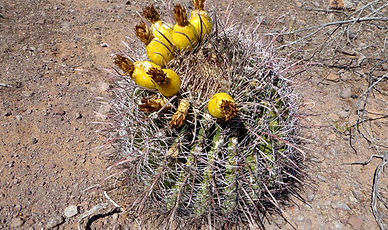
Ferocactus wislizeni (Fishhook / Candy Barrel — primary Arizona edible species); also Ferocactus emoryi (Coville Barrel)
Plant Family: Cactaceae (Cactus Family)
Other Names
Fishhook Barrel Cactus, Candy Barrel Cactus, Compass Barrel Cactus, Arizona Barrel Cactus — Spanish: Biznaga de Agua — Seri: Siml — O'odham: Chiávul
✓ None
⚠ High
⚠ Moderate
⚠ Low
Fruit (fresh and dried), Seeds (ground flour, whole), Flowers and flower buds, Inner pulp (limited, see cautions)
Edible Parts


How to Identify
The Barrel Cactus is one of the most recognizable plants in the Sonoran Desert — a solitary, stout, barrel-shaped column of spines that can grow to impressive heights, producing a crown of flowers and then a ring of small pineapple-like fruits at the top.
Size & Form: The Fishhook Barrel commonly grows 2 to 4 feet high, but some can reach 10 feet. Solitary — does not branch or clump like Prickly Pear or Cholla. The body is a single ribbed column, widest in the middle, tapering toward the base and top. Well-established specimens are genuinely massive — occasionally taller than a person and as wide as a barrel.
Spines: Dense, stout, and formidable. The barrel-shaped body has 20 to 30 ribs that run vertically along its surface. The central spines are hooked — curved inward like a fishhook — which is the primary identification feature of Ferocactus wislizeni and the source of the common name. Spines are red when young, fading to gray with age.
Flowers: The barrel cacti bloom and set fruit in the summer. During the summer months the plant produces large yellow or red flowers on its crown. The flower color of Fishhook is usually orange but can also be yellow or red. Flowers form a crown or ring around the very top of the plant — spectacular when in full bloom.
Fruit: Small oblong shaped fruits with a golden pinkish exterior, topped with the remnants of dried petals. Their fleshy yellow interior surrounds a cavity filled with small black seeds, much like poppy seeds. Fruits look like miniature pineapples clustered at the top of the plant. Barrel cactus fruit is foragable year-round but fresh in the summer and fall.
The Compass Lean: A well-known feature of Ferocactus wislizeni — mature plants often lean toward the southwest, toward the direction of the most intense afternoon sun. This tilt is consistent enough that the plant has been used as a rough compass in the desert — earning it the name "Compass Barrel."
Where and When to Gather
Desert
Habitat: Rocky slopes, bajadas, desert flats, canyon walls, and gravelly hillsides. Native to the southwestern United States and northern Mexico — found in the Sonoran and Chihuahuan deserts. Prefers rocky, well-drained soil in full sun.
Elevation: Below 5,000 feet. Most abundant in the lower Sonoran Desert below 3,500 feet.
Range in Arizona: The most common species in the Tucson area are Ferocactus wislizeni (Fishhook Barrel) and Ferocactus emoryi (Coville Barrel). There are six species of barrel cactus in the region. Ferocactus wislizeni is found across southern and central Arizona — Pima, Pinal, Maricopa, Cochise, Santa Cruz, Yuma, and La Paz counties.
When to Gather:
Flowers and flower buds: Summer — gather fresh flowers or buds during bloom period
Fruit: Fruits are harvested from late November to March for fully ripe fruit, but fresh summer and fall fruit is also edible and at peak flavor August through October
Seeds: Gather from ripe or dried fruit year-round — fruit is foragable year-round as it persists on the plant through winter Mindtrip
Inner pulp: Spring — Papago ate pulp as greens in May Distance Calculator
Elevation Range: Below 5,000 feet
Seasons
Dry Summer
Wet Summer
Fall
✓ Seen / Harvested
Barrel Cactus has shown up on multiple trips across southern Arizona — each visit telling a slightly different part of the seasonal story.
At Saguaro National Park East in September 2025, we came across one of the biggest Barrel Cactus either of us had ever seen — taller than a person, in full bloom with flowers and fruit almost ready at the top. The smaller plants nearby were ahead of the larger one — their fruit already ripe and ready to harvest. The monsoon rains had done their work and the whole area was at peak Barrel Cactus season.
At Picacho Peak in March 2016, the fruit was ripe — a late-season holdover from the previous summer's bloom still clinging to the plants into early spring. At Ironwood Forest National Monument in January 2024, the fruit appeared to be past ripe — dried and spent from the previous season.
Taken together these three visits map the full arc of the Barrel Cactus fruit season — bloom and fresh fruit in late summer following the monsoon, ripe fruit through fall, holdover fruit into winter and early spring, and spent fruit by the following January. If you want to catch the fruit at its best, late August through October is your window.
Boyce Thompson Arboretum

Ironwood Forest National Monument

Picacho Peak State Park

How to Gather
⚠️ Spines are extremely dangerous — thick leather gloves and long sleeves essential at all times.
Fruit:
Use long tongs, two sticks, or a folded paper bag to grip and twist fruit free from the top of the plant
Never reach past the spines with bare hands — the hooked central spines are designed to catch and hold
Place harvested fruit directly into a paper bag or bucket
The fruit skin has small spines — handle carefully and process before eating
The fresh fruit is tart and lemony with hints of rose and guava — harvest ripe fruit when golden-yellow to pink in color Mindtrip
Seeds:
Slice open ripe or dried fruit and scoop out the black seeds
Rinse seeds thoroughly and dry on a screen
The seeds are the size, texture, and taste of poppy seeds and can be used anywhere you use poppy seeds TopoZone
Store dried seeds in a glass jar
Flowers and Buds:
Use tongs to carefully clip fresh flower buds or open flowers from the crown
Gather in the morning during active bloom
Rinse and use fresh or dry quickly
HOW TO USE
Edible Uses
The best cactus tasting fruit comes from the Saguaro, Prickly Pear, and Barrel Cactus. Each part of the Barrel Cactus offers something different to the forager.
Fruit Fresh: The fresh fruit is tart and lemony with hints of rose and guava. Peel away the skin and eat the yellow interior flesh. Mildly tart — pleasant raw in small quantities. You can eat the lemony flavored fruit but only in moderation — fruit is high in oxalic acid which can be hard on human systems.
Fruit in Cooking: The fresh fruit can be added to baked goods, used raw in salads and salsas, or cooked into jam and syrup. The lemon-rose flavor is distinctive and pairs well with other desert fruits.
Seeds: The seeds are just fine to consume in quantity — the size, texture, and taste of poppy seeds and can be used anywhere you use poppy seeds. They can also be cooked in with quinoa or amaranth, or even eaten alone. Once the fruit has dried, the tiny black seeds can be ground into a flour or added whole into crackers, breads, hot cereal, granola, soups, and smoothies.
Flowers and Buds: Fresh flowers and buds are edible raw — mild and slightly tangy. Add to salads or eat as a trail snack. Historically boiled or roasted before eating.
Cactus Candy: Pima used the pulp to make cactus candy. The inner flesh cooked with sugar creates a translucent, sweet candy — a traditional and still-made specialty in Mexico and the American Southwest.
Pulp as Vegetable: Papago ate pulp as greens in May. The inner flesh cooked as a vegetable — mildly flavored.
Medicinal Uses
Barrel Cactus has limited but documented medicinal uses — primarily related to emergency hydration, wound treatment, and digestive support.
Emergency Moisture Source: A widely known but frequently misunderstood use. The Barrel Cactus should not be used as a drinking water source — the Seri Indians of the Sonoran Desert reported headaches, pain, and diarrhea upon attempting to drink this water. They referred to it as the "barrel that kills." However the inner pulp can be chewed to extract limited moisture in extreme emergency — understanding that it is not clean water and may cause illness. This is a true last resort, not a reliable water source.
Salivary Gland Swelling: Mahuna natives used extracts from the cactus to prevent salivary gland swelling.
Wound Treatment: Apache, San Carlos used juice for extreme thirst and as a beverage during hardship. Pulp and juice applied to wounds and skin conditions in traditional practice.
Spines as Tools: The Mahuna employed barrel cactus spines for fishing hooks. The spines of Ferocactus were historically used by Native Americans for crafting tools such as fishing hooks and needles. A material use rather than medicinal, but worth noting — the hooked central spines are precisely shaped for fishhook use.
Native American Uses
Native American tribes across the American Southwest relied on foraged Barrel Cactus fruit as an important food source during the sparse and desolate summer months.
San Carlos Apache: Juice used for extreme thirst. Small black seeds parched, ground, boiled, and eaten as mush.
Papago (Tohono O'odham): Plant tops pounded and juice used as a drink. Pulp eaten as greens in May.
Pima (Akimel O'odham): Juice extracted from pulp and used to quench thirst. Used to make cactus candy. Pulp used as a water substitute for thirst. Plants sliced and cut into small pieces, boiled with mesquite beans and eaten as a sweet dish.
Havasupai: Collected seeds from the fruit and ground them into an edible porridge mush. Warmed the red spines by fire then bent them into finger rings.
Seri: Distinguished three species of barrel cactus by name. Used fruit and pulp as a food and emergency moisture source. Referred to Ferocactus emoryi as "siml cöquicöt" — the killer barrel cactus — due to the toxic effects of drinking its internal liquid.
Mexico — Cactus Candy: In Mexico the flesh of the barrel cactus is candied and eaten as a treat. This tradition continues today — acitrón, made from barrel cactus flesh, is a traditional ingredient in chiles en nogada and other Mexican dishes.
How to Prepare | Recipes
Barrel Cactus Fruit — Fresh
Use tongs to remove fruit from the top of the plant — wear thick gloves
Rinse fruit under running water and scrub any surface spines
Cut off both ends and score the skin lengthwise
Peel away the skin — the yellow interior flesh is the edible portion
The fresh fruit is tart and lemony with hints of rose and guava
Eat raw in moderation — do not consume large quantities due to oxalic acid content
Add to salads, salsas, or use as a garnish
Barrel Cactus Seed Porridge (Traditional)
Collect seeds from ripe or dried fruit — rinse thoroughly
Spread seeds on a dry pan and parch over medium heat, stirring constantly until lightly toasted
Grind in a blender or stone mortar until a coarse flour forms
Bring 2 cups water to a boil — whisk in ½ cup seed flour
Simmer stirring constantly for 5–8 minutes until thickened
Sweeten with honey or agave — serve warm as porridge
Barrel Cactus Seeds — Whole in Cooking
Collect seeds from ripe fruit — rinse and dry thoroughly
Use anywhere you use poppy seeds — add whole to crackers, breads, hot cereal, granola, soups, and smoothies
No preparation required beyond rinsing and drying — ready to use
Barrel Cactus Fruit Salsa
Peel and dice 6–8 fresh barrel cactus fruits
Combine with diced red onion, jalapeño, cilantro, and lime juice
Add a pinch of salt
Let sit 15 minutes for flavors to meld
The lemony tart fruit makes a distinctive desert salsa — serve with chips or alongside grilled meats
Traditional Pima Sweet Dish
Slice fresh barrel cactus pulp into small pieces
Combine with cooked mesquite bean pods or mesquite flour
Boil together and eat as a sweet dish
The natural sugars in both mesquite and barrel cactus create a naturally sweet, nutritious meal
Cautions
Fruit is high in oxalic acid which can be hard on human systems — eat fresh fruit in moderation only. Seeds do not carry this concern and can be consumed in larger quantities.
Do not use Barrel Cactus as a drinking water source — the liquid inside is far too alkaline. The Seri Indians reported headaches, pain, and diarrhea upon attempting to drink this water. This is one of the most dangerous desert survival myths — do not rely on it.
Spines are extremely dangerous — hooked central spines are designed to catch and hold. Thick leather gloves and long sleeves mandatory at all times. The hooked spines can penetrate deeply and are very difficult to remove.
The "compass lean" is a general tendency not a precise navigation tool — do not rely on it for desert navigation.
No toxic look-alikes — Barrel Cactus is distinctive and not easily confused with toxic plants.
Do not harvest from protected lands without a permit.
⚠️ DISCLAIMER This information is provided for educational purposes only. Always positively identify any plant before consuming or using medicinally. When in doubt, do not harvest. Consult a qualified healthcare provider before using any plant for medicinal purposes. Some plants have toxic look-alikes — never rely on a single source for identification. AZ Places and Rachel Joel assume no responsibility for misidentification or misuse.


