
Ironwood Forest National Monument
AtoZ Places Bucket Location


Abandoned & Ghost Towns

Ancient Ruins

Caves

Desert

Forest

Historical

Hot Springs

Lakes & Rivers

National & State Parks

Peaks


Ironwood Forest National Monument northwest of Tucson covers 129,000 acres of the most biologically dense Sonoran Desert in Arizona — named for the ancient ironwood trees that anchor its desert ecosystem, home to more saguaro per acre than Saguaro National Park, desert bighorn sheep, Hohokam petroglyphs, and unlimited dispersed camping on BLM land with genuine solitude just an hour from Phoenix or Tucson.
Desert
National & State Parks
Abandoned & Ghost Towns

Wildlife

Hiking

Exploring

Camping

Camping: Dispersed camping allowed up to 14 consecutive days.

Water: No potable water; pack your own supply.
More Info
Plants Foraged
Barrel Cactus

Ocotillo
Prickly Pear

Nearby Locations
Casa Grande Ruins National Monument

Kitt Peak National Observatory

Titan II Missile Interpretive Site

Silver Bell Cemetery
Sasco Ghost Town
Ironwood Forest National Monument
The sign on I-10 says Ironwood Forest National Monument. Most people keep driving. That's fine — the monument rewards the ones who turn off.
129,000 acres of Sonoran Desert northwest of Tucson, established in 2000, managed by the Bureau of Land Management. Named for the ironwood trees (Olneya tesota) that grow throughout — one of the longest-lived and ecologically significant trees in the Sonoran Desert, with a lifespan reaching 1,500 years. The ironwood is a nurse plant that shelters young saguaros and dozens of other species in its shade. An ironwood forest is not a forest in the conventional sense but a dense community of ironwood, saguaro, palo verde, cholla, ocotillo, and barrel cactus that represents the full expression of the lower Sonoran Desert ecosystem.
The saguaro density in Ironwood Forest National Monument is exceptional — miles of saguaro in every direction, from the road to the horizon, standing in concentrations that represent some of the most impressive saguaro habitat in the Sonoran Desert. The monument contains more than 200 documented Hohokam archaeological sites alongside this biological richness — a landscape that has been significant to human and desert life for well over a thousand years.
Our Visit — January 19–21, 2024
Matthew, Luca, and I camped two nights in January 2024 — a winter visit that delivered everything the monument has to offer at its most comfortable.
The Camp

Along the main roads through the monument we noticed numerous camping spots available. Being in the truck we ventured off W Silverbell Road and found a great spot centered below the saddle between two peaks — the best location in the immediate area and one that gave us shelter, privacy, and the view we were looking for. We were the only ones in the area. One other camper sat a good distance away. One other vehicle passed us on the way in. That was the full extent of the human presence in our corner of the monument for two nights.
The Hike to the Saddle
We hiked up to the saddle between Ragged Top and Wolcott Peak — steep and short but the views from the top looked out over two valleys with the monument spreading in every direction below. The saddle itself is a classic desert ridgeline — the kind of place where the wind moves through and the scale of the landscape settles in. We found an overhang in the rock where animals had clearly been sheltering — signs of use by the desert bighorn sheep the monument is known for, or other wildlife that had found the shade and protection of the rock face above. We didn't see the sheep from here but found them on the hills the following day.
What We Found
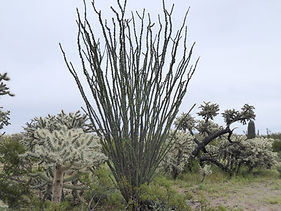
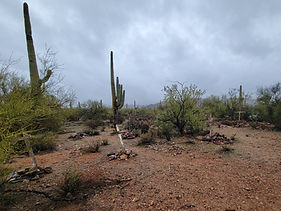
The desert floor and the hillsides delivered a full inventory of what Ironwood Forest holds. Ironwood trees throughout — some of them genuinely ancient, their twisted gray trunks and dense crowns visible from a distance. Barrel cactus on the rocky slopes. Cholla — beautiful, consequential, watch every step. Ocotillo with the bare winter stems that will be tipped in red flowers come spring. Miles of saguaro on every slope.
We found a downed saguaro — all that remained was a pile of saguaro boots. When a saguaro dies and its outer flesh decomposes, the woody internal ribs and the fibrous boots — the hardened linings of the cavities excavated by birds — remain as artifacts of the living plant. A pile of boots on the desert floor is all that's left of a saguaro that may have stood for 150 years.
Old rusted tin cans scattered in the desert scrub — the detritus of past human occupation, miners and ranchers who passed through this country long before the monument existed.
Signs of javelina throughout — the distinctive evidence of a cactus destroyed by their rooting and feeding. Javelina regard saguaro and prickly pear as food regardless of what the cactus has to say about it.
We ran across hunters in the area — javelina hunting is permitted in Ironwood Forest National Monument on valid Arizona hunting licenses. This is public land managed for multiple uses and hunting is one of them. Worth knowing before you go, particularly if you're hiking off-trail.
At night the calls of owls carried through the desert. During walks I spotted a large jackrabbit moving through the scrub.
The Mystery Stones — Possible Meteorites?

Among our finds were metallic stones that don't read as typical desert rock — heavy for their size, different in surface texture, and with a quality that makes you stop and look twice. The flat desert surrounding Ironwood Forest National Monument sits within a region of Arizona with documented meteorite finds. Desert rock from this area can also have iron-rich surfaces that appear metallic — the geology of the Silverbell Mountains produces iron-oxide bearing minerals that look similar. The honest answer is that field identification of meteorites is difficult — the only reliable method is testing. If you find something that feels genuinely different from the rocks around it, keep it separately, note the location, and have it examined. It may be volcanic. It may be something more interesting.
The Desert Bighorn Sheep
Desert bighorn sheep inhabit the rocky slopes and ridgelines of the monument — the Silverbell Mountains and Ragged Top provide the terrain they prefer. We didn't spot them at the overhang on the hike but found them on the hillsides the following day. Seeing bighorn sheep in their natural habitat in the Sonoran Desert is one of the genuinely remarkable wildlife experiences the monument offers — patient and quiet movement through the terrain is the key.
The Ironwood Tree — Why It Matters

The monument is named for Olneya tesota — the desert ironwood — and the name is worth understanding. Ironwood is the heaviest wood in North America — denser than water, it sinks. It burns hot enough to melt aluminum. The tree grows slowly for decades before reaching maturity, lives up to 1,500 years, and serves as what ecologists call a nurse plant — creating shade, cooler temperatures, and more moisture in the soil beneath its canopy that allows young saguaros, palo verdes, and dozens of other species to establish themselves where they otherwise couldn't survive the exposed desert sun. An ironwood tree is not just a tree — it's a habitat in itself. The dense population of ironwood trees in this monument is the foundation of the entire desert ecosystem around them.
Archaeology — Hohokam Sites and Petroglyphs
The monument contains significant archaeological sites — remnants of ancient Hohokam settlements and petroglyphs created by Native American tribes over centuries of occupation in this desert. The BLM manages these sites within the monument boundaries. Rock art sites are present in the area — do not touch or disturb any petroglyphs or archaeological features.
A Note on the Saguaro
If this is your first time in a landscape with this density of saguaro it is worth slowing down for. Miles of the largest cactus in the United States standing on every slope — some with dozens of arms, indicating ages of 150 years and more, others with bird cavity holes from generations of Gila woodpeckers and elf owls. The boots we found on the desert floor from the downed saguaro are a physical record of that lifespan — the hollow forms that protected nesting birds for decades, outlasting the plant itself.
#IronwoodForestNationalMonument #IronwoodForest #SonoranDesert #BLMCamping #DispersedCamping #Saguaro #IronwoodTree #DesertCamping #ArizonaWildlife #AZPlaces #PimaCounty #MaricopaCounty #BigHornSheep #FreeCamping #ArizonaDesert
Dispersed Camping

Arizona
Ironwood Forest National Monument, Marana, AZ 85653, United States

Pima County
32°28'02.8"N 111°28'29.6"W
Elevation: 2200 feet
Directions
The Ironwood Forest National Monument is located 25 miles northwest of Tucson and about one hour by highway south of Phoenix. There are two main points of entry: Interstate 10 at Avra Valley Road, and Interstate 10 from the Red Rock exit southwest on Sasco Road to Silverbell Road. Hike Arizona
Entry via Marana / Silverbell Road (recommended — paved access):From Tucson, take Interstate 10 west to Marana. Take Exit 236, turn left on Sandario Road for 0.1 mile, then turn right on Marana Road and go west about 5.8 miles to Silver Bell Road. Continue on Silver Bell Road to travel through the Ironwood Forest National Monument. Hike Arizona
Entry via Avra Valley Road (alternate — paved most of the way):Take Avra Valley Road starting from Exit 242 of I-10 at Rillito. Head west approximately 10 miles through farmland and into the monument. Turn left onto Silver Bell Road (gravel) and follow it through the western foothills of the Silver Bell Mountains past Ragged Top Peak. Arizona Leisure
Entry via Red Rock / Sasco Road (northern approach):Take Sasco Road from the Red Rock exit off I-10. Proceed west to the sign and turn left onto Silverbell Road. You can follow Silverbell Road back to the freeway or take Pump Station Road to Avra Valley Road and return to I-10 that way. Note: The Santa Cruz River crossing at Sasco Road is often closed — check road conditions with the BLM before planning this route. AllTrailsAllTrails
From Chandler, AZ: Take I-10 South approximately 80 miles to the Marana Exit 236. Follow Marana Road west to Silverbell Road as above. (~80 miles, ~1 hour 15 minutes — verify with Google Maps)
Road conditions note: Some roads are rugged — high clearance or four-wheel-drive vehicles are recommended in those areas. Vehicles must stay on existing routes. Four-wheel drive is advisable during monsoon season when flash flooding can alter road conditions rapidly. Never attempt to cross a flowing wash. Distance CalculatorHike Arizona


Best Seasons & Temperatures
The best time to visit Ironwood Forest National Monument is November through March when the weather is cooler. Summer temperatures easily top 110 degrees Fahrenheit — something to keep in mind if planning a visit between May and September. Spring brings wildflower blooms and is especially popular for photography. Monsoon season (July–September) brings flash flooding risk on dirt roads — check conditions before entering the monument. The Sasco Road river crossing is frequently impassable after rain year-round.
Ironwood Forest National Monument
January 19-21 2024