

Fendler's Buckbrush
✓ Edible
✓ Medicinal

Ceanothus fendleri
Plant Family: Rhamnaceae (Buckthorn Family)
Other Names
Fendler's Ceanothus, Buckbrush, Deer Brier, Wild Lilac — Spanish: Ceanoto de Fendler
✓ None
⚠ High
⚠ Moderate
⚠ Low
Fruit (immature capsules — technically edible, not recommended)
Edible Parts
How to Identify
Fendler's Buckbrush is a distinctive evergreen shrub of Arizona's mountain forest understory — the combination of small alternate leaves, clusters of tiny white flowers, spiny branch tips, and triangular three-lobed fruit capsules making it identifiable once you know the features to look for.
Size and Form: A low to medium evergreen shrub typically reaching 1 to 3 feet tall — occasionally taller at lower elevations. Dense and spreading, often forming low thickets in favorable locations. The stems are greenish-brown to gray with smooth bark and branch tips that end in a stout sharp spine — the spine is a reliable identification feature.
Stems: Greenish-brown to bluish-gray, smooth barked, with a characteristic spine at the branch tip. The young stems are fuzzy or slightly hairy.
Leaves: Small, alternate, dull dark green above and pale grayish-green and hairy below — oblanceolate to oblong in shape, 1/2 to 1 inch long. Three major veins run lengthwise from the base of each leaf — a distinctive feature of the Ceanothus genus. The leaves are evergreen — persistent year-round making the plant identifiable in all seasons.
Flowers: Small, white, five-petaled with five spoon-shaped petals and five white folded triangular sepals — produced in rounded clusters along the branch tips. The individual flowers are tiny but the clusters are showy and intensely fragrant — a sweet, slightly soapy floral scent that is distinctive and pleasant. Blooms April through October in Arizona — peak bloom May through July. The flowers are intensely attractive to bees and moths.
Fruit: Small, plump, triangular three-lobed capsules — green when immature turning red and finally drying to brown at maturity. The red immature fruit is what you described at Pinery Creek — striking and berry-like in appearance but not a true berry. The three-lobed capsule structure distinguishes it from true berries. The fruit has a distinctive acrid, bitter, soapy taste from saponin content.
Root: The most significant part medicinally — the root bark has a distinctive red-orange to red-brown color giving the plant its herbal name Red Root. The red color is immediately apparent when a root is scraped or cut.
Habitat: Dry rocky soils, foothills, rocky mountain slopes, pinyon-juniper woodland, ponderosa pine forest, and mixed conifer zones at 4,000 to 10,000 feet. Found in both partial shade and open sunny areas in the mountain forest understory. Classic Fendler's Buckbrush habitat in Arizona is the rocky slope understory of a sky island canyon — exactly the Pinery Creek habitat where you found it in May 2026.
Look-alike note: Other Ceanothus species grow in Arizona — Ceanothus greggii (Desert Ceanothus) occurs at lower elevations. The combination of three-veined leaves, spiny branch tips, white flower clusters, and triangular three-lobed fruit capsules identifies the Ceanothus genus. All Arizona Ceanothus species share the same high-saponin fruit caution and similar medicinal properties — treat them identically for foraging purposes. Possible confusion with Rhamnus species (buckthorns) — the three-veined leaves and distinctive flower clusters distinguish Ceanothus from Rhamnus.
Where and When to Gather
Forest
Habitat: Rocky mountain slopes, pinyon-juniper woodland, ponderosa pine forest, and mixed conifer zones. Found in both partial shade and open rocky areas in the mountain forest understory.
Elevation: 4,000 to 10,000 feet — most abundant in the 5,000 to 9,000 foot mountain forest zones.
Range in Arizona: Found throughout the mountain ranges of central and southeastern Arizona — Coconino, Yavapai, Graham, Cochise, Santa Cruz, and Pima counties. Common in the Chiricahua Mountains, Huachuca Mountains, Santa Catalina Mountains, White Mountains, and Mogollon Rim country. Confirmed location: Pinery Creek, Chiricahua Mountains — May 3, 2026.
Also found: Arizona, New Mexico, Colorado, Utah, Wyoming (east), South Dakota (west), Texas, and northern Mexico — Chihuahua and Coahuila.
When to Gather:
Root: Fall through early spring — best harvested when the plant is dormant. The red root bark is the primary medicinal harvest. Take only a small lateral root from large established plants — never harvest the taproot.
Flowers: May through July — harvest fresh flower clusters for external soap applications and tea.
Elevation Range: 4,000 to 10,000 feet
Seasons
Spring
Fall
Winter
✓ Seen / Harvested
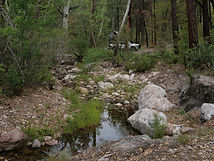
First identified at Pinery Creek, Chiricahua Mountains — May 3, 2026 Chiricahua road trip. The red immature fruit capsules at Pinery Creek in May represent the plant in active fruit production — peak bloom is April through July at this elevation in the Chiricahua sky island range. Classic Fendler's Buckbrush habitat — rocky canyon slopes in mixed conifer forest of a southeastern Arizona sky island. Photos available. Not yet harvested.
Pinery Creek
How to Gather
Root — medicinal use:
Harvest only lateral roots from large well-established plants — never the taproot which will kill the plant
Use a trowel to expose a lateral root — cut a section 6 to 12 inches long
The red-orange bark on the root is immediately visible when cut — this confirms identification
Allow the harvest wound to dry before covering with soil — reduces infection risk to the plant
Chop harvested root into small pieces and dry completely before storage
Store dried root in a sealed glass jar — keeps well for several years
Flowers — external use:
Harvest fresh flower clusters at peak bloom
Rub between hands with water to create a lather — used as a natural soap or shampoo
Do not consume large quantities of flower tea internally due to saponin content
Ethical harvest:
Fendler's Buckbrush is critically important browse for mule deer and elk — constituting up to 6.9% of mule deer summer diet at some Arizona locations. Leave the majority of the plant untouched.
Never harvest roots from small or isolated plants
Never harvest from protected lands without a permit
HOW TO USE
Edible Uses
The edible applications of Fendler's Buckbrush are limited and generally not recommended. The fruit capsules are technically edible — described as red and berry-like when immature — but the taste is acrid, bitter, and soapy due to high saponin content. Cooking has little effect on the flavor or saponin content. The Foraging Center notes clearly: "consumption of these wild foods is not recommended due to the overabundance of saponins."
Ethnobotanical references document immature fruits being cooked as mush by some Native peoples — but this is a survival food application rather than a preferred food. The leaves of related Ceanothus species (particularly Ceanothus velutinus) have been used to make tea — the same saponin caution applies.
The honest assessment: Fendler's Buckbrush is primarily a medicinal and ecological plant. The edible applications are marginal at best and unpleasant at worst. Focus on the medicinal root and the ecological significance — not the fruit.
Medicinal Uses
Fendler's Buckbrush — known to herbalists as Red Root — is one of the more significant medicinal plants in the western mountain forest pharmacopoeia. The root bark contains ceanothine and other alkaloids along with tannins and saponins that give it documented lymphatic, immune, and digestive properties.
Lymphatic System — the primary application: Red Root is considered one of the best lymphatic herbs available in western herbal medicine. Charles Kane documents it as a "long-term low-level approach" for lymphatic congestion — swollen lymph nodes, chronic tonsillitis, and sluggish lymphatic circulation. The plant is not a dramatic acute remedy but a gentle long-term support for lymphatic function. Consider it for persistent lymph node swelling, chronic low-grade infections, and general immune sluggishness.
Immune Support: The alkaloids in the root bark have documented immune-modulating properties — stimulating immune function over time with regular use. Occasionally promoted as an anti-viral herb — the evidence for specific anti-viral activity is limited but the general immune support application is well-documented in western herbal practice.
Spleen Support: Traditional and contemporary herbal use documents Red Root as a spleen tonic — supporting spleen function in filtering blood and supporting immune cell production.
Digestive: Root decoction used for digestive complaints — the tannin content providing astringent action on inflamed digestive tissue.
Blood Coagulation: The plant has mild pro-coagulant properties — traditionally used to slow excessive bleeding. This property is also the source of the primary drug interaction caution — see Cautions section.
Native American Uses
Fendler's Buckbrush has documented Native American use primarily in the medicinal and material culture categories rather than as a food plant.
Immature fruit as food: Ethnobotanical references document immature fruits being cooked as mush — a survival food application among peoples within the plant's range. The high saponin content made this a marginal food source used when better options were unavailable.
Cleansing applications: Leaves and flowering tops used to make cleansing foams, shampoos, and external washes — the saponin content producing a genuine lather useful for personal hygiene.
Browse value: The plant's most consistent traditional ecological value was recognized by Native peoples who observed mule deer, elk, pronghorn, jackrabbits, and porcupines feeding heavily on the plant — indicating its nutritional significance in the mountain ecosystem even if the saponin content makes it marginal for human consumption.
Wildlife significance: Fendler's Buckbrush constitutes up to 6.9% of mule deer summer diet at Beaver Creek, Arizona — a significant dietary component for one of Arizona's most important game animals. Elk also eat it heavily. The plant is a critical wildlife browse species throughout its Arizona mountain range. The caterpillars of the Buckthorn Duskywing butterfly (Erynnis pacuvius) feed specifically on Ceanothus species — Fendler's Buckbrush is a larval host plant for this butterfly.
How to Prepare | Recipes
Red Root Tincture — primary medicinal preparation:
Harvest lateral root section from a large established plant
Scrape the outer bark — the red-orange color confirms identity and indicates the active compounds
Chop fresh root into small pieces — approximately 1/4 inch
Place in a clean glass jar — fill to 2/3 full with chopped root
Cover completely with 80-proof vodka or apple cider vinegar
Seal and store in a cool dark location for 4 to 6 weeks — shake daily
Strain through cheesecloth pressing to extract all liquid
Store tincture in dark glass dropper bottles
Standard use: 20 to 30 drops in water, 2 to 3 times daily — do not exceed recommended doses
Red Root Decoction:
Simmer 1 tablespoon chopped dried root in 2 cups water for 20 minutes
Strain and cool
Drink 1/2 cup 2 to 3 times daily for medicinal applications
Mild, slightly earthy flavor — more palatable than the fruit
Natural Soap — flower lather:
Harvest a handful of fresh flower clusters at peak bloom
Rub between wet hands — the saponins produce a genuine lather
Use as a natural hand or hair wash
Rinse thoroughly
A traditional external use that makes practical use of the saponin content
Cautions
⚠️ Fruit — high saponin content: The fruit tastes acrid, bitter, and soapy — consumption is not recommended. Saponins in large quantities can cause digestive irritation and red blood cell hemolysis. The fruit is technically edible in small quantities but the flavor and saponin content make it an unappealing and potentially problematic food source.
Blood thinning medications — important interaction: Red Root has mild pro-coagulant properties. Individuals taking blood thinners (warfarin, aspirin therapy, heparin) should not use Red Root medicinally without consulting a healthcare provider — the pro-coagulant effect can interfere with anticoagulant therapy.
Pregnancy: Avoid medicinal use of the root during pregnancy — the active alkaloids have not been studied for safety in pregnancy.
Long-term use: Red Root is a long-term low-level remedy — not appropriate for short-term acute treatment or high-dose acute use.
Identification: Confirm three-veined leaves, spiny branch tips, white flower clusters, and triangular three-lobed fruit capsules before any use. The red root bark on a cut lateral root is the most reliable confirmation of species.
Never harvest taproot — kills the plant. Lateral roots only from large established plants.
⚠️ DISCLAIMER This information is provided for educational purposes only. Always positively identify any plant before consuming or using medicinally. When in doubt, do not harvest. Consult a qualified healthcare provider before using any plant for medicinal purposes. Some plants have toxic look-alikes — never rely on a single source for identification. AZ Places and Rachel Joel assume no responsibility for misidentification or misuse.


