

Coyote Mint
✓ Edible
✓ Medicinal
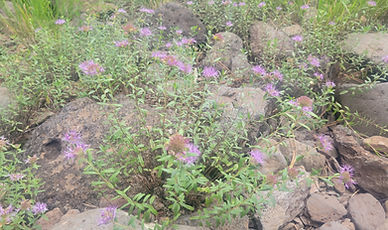
Monardella odoratissima
Plant Family: Lamiaceae (Mint Family)
Other Names
Mountain Coyote Mint, Mountain Pennyroyal, Mountain Beebalm, Mountain Monardella, Desert Mint, Western Pennyroyal — Spanish: Menta Coyote
✓ None
⚠ High
⚠ Moderate
⚠ Low
Leaves and stems (tea, seasoning, fresh), Flowers (garnish, tea)
Edible Parts


How to Identify
Coyote Mint announces itself before you see it — the fragrance carried on warm air or released by brushing against the plant is the most immediate and reliable identification feature. The scent is extraordinary — a powerful, clean combination of mint and marjoram or oregano that is unlike any other plant in the Arizona mountain forest environment. Once you have smelled it, you will recognize it instantly on every future encounter.
Size and Form: A low-growing, spreading, semi-woody perennial herb typically reaching 6 to 18 inches in height and 2 to 3 feet wide. The plant has a stout taproot and branching woody base that supports a sprawling, mat-forming growth habit. Often grows in dense patches where conditions are favorable — rocky slopes, canyon bottoms, and open sunny clearings in the mountain forest.
Stems: Square in cross-section — the characteristic stem shape of the entire mint family. Stems are branched, somewhat woody at the base, light green to gray-green, and covered in fine soft hairs. The square stem is a reliable family identification feature.
Leaves: Small, oval to lance-shaped, 1/4 to 3/4 inch long, opposite on the stem — another mint family characteristic. Light green to gray-green with a slightly rough texture and fine hairs. The leaves are the primary source of fragrance — crush a single leaf and the mint-marjoram aroma is released immediately and powerfully. Leaf edges may be entire or slightly toothed depending on the subspecies.
Flowers: The most visually distinctive feature — spherical to dome-shaped flower heads approximately 1 inch across, composed of numerous small tubular two-lipped flowers in a tight whorled arrangement. Flower color ranges from pale lavender to deep purple — typically a rich purple-pink. A whorl of leafy bracts surrounds the base of each flower head, often tinged purple. The overall appearance is a small purple pom-pom rising from the gray-green foliage — striking and unmistakable in the summer mountain landscape. Blooms June through September in Arizona depending on elevation.
Fragrance: The defining characteristic — intensely aromatic, described as a mashup of mint and marjoram, leaning more toward the marjoram-oregano side than straight mint. One forager (Hank Shaw) describes it as "pennyroyal leans more toward the mint side, coyote mint leans more toward the marjoram side." The fragrance is released by touch, by warm sun, and by any disturbance to the plant. The first encounter with Coyote Mint in the field is consistently described as one of the most memorable olfactory experiences in wild plant foraging.
Habitat: Open rocky places in forested terrain — rock outcrops, talus slopes, ridgelines, canyon bottoms, and open sunny clearings in ponderosa pine, mixed conifer, and sagebrush scrub zones. Found in full sun to part shade at elevations from 3,000 to 10,000 feet. Often growing on dry, well-drained soils in areas with good sun exposure.
Look-alike note: Other Monardella species grow in Arizona — Monardella arizonica (Arizona Monardella) is endemic to northern Arizona and found in pinyon-juniper woodland. All Monardella species are fragrant and all are safe to use as culinary and medicinal herbs — there are no toxic look-alikes in the Monardella genus. The square stem and opposite leaves identify the plant as a mint family member — combined with the distinctive fragrance and purple pom-pom flowers the identification is essentially unmistakable.
Where and When to Gather
Forest
Habitat: Rocky slopes, canyon bottoms, open sunny clearings, and rock outcrops in mountain forest and sagebrush scrub zones. Most common in full sun to light shade on well-drained soils. Found in the canyon bottom along FR 230D, Coconino National Forest — September 2026.
Elevation: 3,000 to 10,000 feet in Arizona — most abundant in the 5,000 to 8,500 foot range in the mountain forest zones.
Range in Arizona: Coconino, Yavapai, Apache, Navajo, and Coconino counties — throughout the Mogollon Rim corridor, White Mountains, and high plateau country. The Coconino National Forest canyon systems in the Mogollon Rim Ranger District are prime Coyote Mint habitat.
Also found: Throughout the western mountains from British Columbia south to Arizona and Colorado — one of the most widespread Monardella species in North America.
When to Gather:
Leaves and stems: Spring through fall — best gathered just before or during flowering when aromatic compound concentration is highest. Morning gathering after the dew has dried preserves the best fragrance and flavor.
Flowers: June through September — harvest at peak bloom for garnish and tea use.
Elevation Range: 3,000 to 10,000 feet
Seasons
Spring
Dry Summer
Wet Summer
Fall
✓ Seen / Harvested
First encountered in the canyon bottom along FR 230D, Coconino National Forest — September 4–7, 2026 Jacks Canyon camping trip. Immediately recognized by fragrance before visual identification — the most extraordinary plant fragrance encountered in years of Arizona field foraging. The description that best captures the scent: a powerful combination of fresh mint and marjoram, cleaner and more complex than either alone. Found in the canyon bottom — the moist shaded microhabitat of the FR 230D drainage providing ideal conditions for this species at approximately 6,800 feet elevation. Not yet harvested — the September encounter was after peak bloom. Return visit during June through August bloom season would allow harvest of both flowers and leaves at peak aromatic compound concentration.
Jacks Canyon (FR 230)

How to Gather
Leaves and Stems:
Harvest the top 3 to 4 inches of actively growing stems — this encourages bushier regrowth
Use scissors or pinch with fingers — the stems break cleanly
Gather in the morning after dew has dried and before midday heat reduces aromatic compound concentration
Use fresh immediately — the fragrance and flavor are most intense fresh
For drying: bundle stems loosely and hang in a warm dry location with good airflow — or dry on a screen. The dried herb retains excellent flavor and fragrance — one of the better-drying culinary herbs available from Arizona wild plants
Store dried herb in a sealed glass jar away from light — keeps well for one year
Flowers:
Harvest individual flower heads when fully open
Use fresh as a garnish or dry for tea
The flowers are the most visually attractive part of the plant for presentation purposes
Ethical harvest:
Coyote Mint is a critical pollinator plant — butterflies, native bees, hummingbirds, and pollinating flies all work the flowers heavily. Leave the majority of flowers on each plant for pollinators.
Harvest no more than one third of any plant at a time — the plant regrows readily from the woody base
Never harvest from protected lands without a permit
HOW TO USE
Edible Uses
Coyote Mint is one of the finest wild culinary herbs available in Arizona's mountain forests — the flavor profile of mint-meets-marjoram makes it versatile in cooking applications where either herb would be used. The flavor is more complex than culinary mint — less aggressively minty, with a warm herbal quality that works well with meat, vegetables, and in drinks.
The leaves and stems are used fresh or dried as a seasoning — substituting directly for mint or marjoram in any recipe. The fragrance intensity of fresh Coyote Mint in the field translates to an equally intense culinary herb when used fresh. Dried Coyote Mint concentrates the flavor further.
Fresh leaves are excellent in drinks — a few bruised leaves in cold water or lemonade create a genuinely refreshing beverage with a complex herbal character. The herb pairs exceptionally well with lamb, venison, and other game meats — the marjoram character making it a natural companion to the flavors of wild meat.
Medicinal Uses
Coyote Mint has a broad and well-documented medicinal record across western Native peoples — primarily as a tea for respiratory conditions, fever, headache, and digestive complaints.
Respiratory: The aromatic compounds in Coyote Mint — primarily carvacrol, thymol, and related monoterpenes — have documented antimicrobial and expectorant properties. A strong tea of Coyote Mint for colds, congestion, and respiratory infections is one of the most consistently documented traditional uses. The steam from a hot cup of Coyote Mint tea provides additional inhalation benefit for congestion.
Fever: Tea used to reduce fever — the diaphoretic (sweat-inducing) properties of the aromatic compounds promote perspiration and support the body's natural fever management process. One of the most broadly documented Native American medicinal uses for the plant.
Headache: Crushed leaves applied to the temples or inhaled — the aromatic compounds have analgesic and vasodilatory properties that support headache relief. Tea also used internally for headache.
Digestive: Tea used for digestive complaints — nausea, indigestion, and stomach upset. The carminative properties of the aromatic compounds relieve gas and digestive cramping. Similar to culinary mint in digestive applications.
Insect repellent: The strongly aromatic compounds repel insects — crushed leaves rubbed on exposed skin provide mild insect repellent effect. A traditional use documented across multiple western Native traditions.
Native American Uses
Coyote Mint was used medicinally and as a food seasoning across Native peoples of the western mountains — virtually every group within its range recognized and used the plant.
Okanagan-Colville: Plant rubbed on the body as a deodorant and insect repellent. Tea used medicinally.
Paiute: Tea used for colds and fever. Leaves used as a seasoning for food.
Shoshoni: Tea used for headaches and fever. Plant used as a general medicinal herb.
Kawaiisu: Tea used for cold and flu symptoms.
General western use: The plant's powerful fragrance made it immediately recognizable and valuable to every culture within its range. The consistent pattern of tea use for respiratory and fever conditions across unrelated Native traditions reflects genuine medicinal efficacy — independent observations of the same therapeutic effect.
Wildlife significance: Coyote Mint is one of the most important pollinator plants in western mountain ecosystems — butterflies are the primary pollinators, with native bees, hummingbirds, and pollinating flies also heavily using the flowers. The plant is deer-resistant — the strong aromatic compounds making it unpalatable to deer, which helps maintain populations in heavily browsed areas.
How to Prepare | Recipes
Coyote Mint Tea — the primary traditional preparation:
Harvest 1/4 cup fresh leaves and stems — or 1 tablespoon dried
Bruise the leaves lightly by pressing between fingers to release aromatic compounds
Pour boiling water over the herb
Steep 5 to 10 minutes — taste at 5 minutes and adjust steeping time to preference
Strain and sweeten with honey if desired
The tea is intensely aromatic — mint-marjoram character, clean and refreshing
Serve hot or cold — excellent as an iced tea in summer
Camp Rose Hip and Coyote Mint Tea:
Combine 1 tablespoon crushed fresh rose hips with 1 tablespoon fresh Coyote Mint leaves
Simmer in 2 cups water for 10 minutes
Strain and sweeten with honey
The combination of rose hip tartness and Coyote Mint herbal character is exceptional
This combination was available on our September 2026 camp — both plants present in the same area
Fresh herb seasoning:
Harvest fresh Coyote Mint leaves just before use
Chop finely and use as you would fresh mint or marjoram
Excellent with lamb, venison, roasted vegetables, and in grain dishes
Add at the end of cooking to preserve fresh flavor
1 tablespoon fresh Coyote Mint = approximately 1 teaspoon culinary mint or marjoram
Chimichurri with Coyote Mint:
Combine 1/2 cup finely chopped Coyote Mint leaves with 1/4 cup olive oil
Add 2 tablespoons red wine vinegar, 2 cloves minced garlic, salt and pepper
Allow to rest 30 minutes before using
Use as a sauce for grilled meat — exceptional with venison and elk
One of the finest applications for this herb according to forager Hank Shaw
Dried herb storage:
Harvest stems at peak bloom — the highest aromatic compound concentration
Bundle loosely with twine and hang upside down in a warm dry location
Or spread on a drying screen — dry until completely desiccated
Strip dried leaves from stems and store in a sealed glass jar
Labeled with harvest date and location — keeps well for one year
Cautions
Pennyroyal caution — not related: Coyote Mint is sometimes called Mountain Pennyroyal but is NOT related to true pennyroyal (Mentha pulegium) which contains pulegone — a compound that is toxic in large quantities and unsafe during pregnancy. Monardella odoratissima does not contain pulegone and does not share this toxicity. The common name overlap is misleading — the plants are in different genera with different chemical profiles.
Pregnancy: Moderate quantities of Coyote Mint tea are generally considered safe. Large medicinal doses of strongly aromatic herbs are traditionally avoided during pregnancy as a precaution — use culinary quantities freely, large therapeutic doses with caution.
Allergy: Individuals with known sensitivity to mint family plants (Lamiaceae) should introduce cautiously.
Harvest sparingly: Leave the majority of flowers for pollinators — Coyote Mint is a critical summer nectar source for butterflies, bees, and hummingbirds in mountain forest zones.
Identification: The square stem, opposite leaves, purple pom-pom flowers, and intensely mint-marjoram fragrance make Coyote Mint essentially unmistakable. There are no toxic look-alikes in the Monardella genus.
⚠️ DISCLAIMER This information is provided for educational purposes only. Always positively identify any plant before consuming or using medicinally. When in doubt, do not harvest. Consult a qualified healthcare provider before using any plant for medicinal purposes. Some plants have toxic look-alikes — never rely on a single source for identification. AZ Places and Rachel Joel assume no responsibility for misidentification or misuse.


